When Parents Oppose a Religious Path
Rabbi Yaakov Galinsky offers encouragement to a couple whose parents withdrew their support when they chose to study Torah.
In brief
- A couple lost their parents’ financial support after the husband began studying Torah.
- Rabbi Galinsky told them that the natural world offers lessons about God’s care.
- He encouraged them to trust God and remain connected to their parents.
Parashat Re'eh#
“You are children of the Lord your God” [Deuteronomy 14:1].
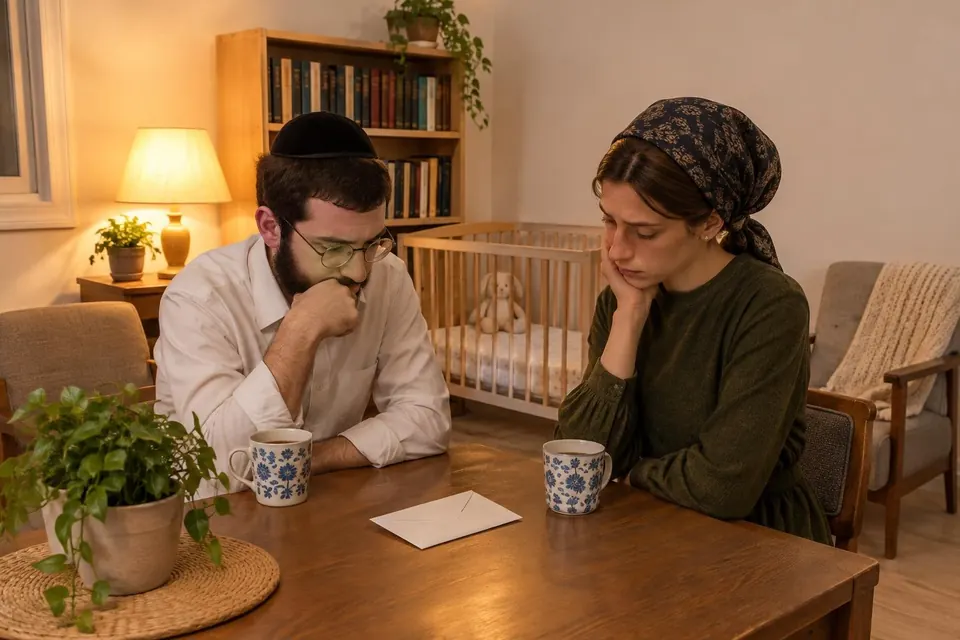
A couple once came to me to ask for a blessing. As if they needed one. The husband was an engineer from a very wealthy family. When he finished his studies, his parents set him up in a luxurious office. When he married, they rented him a villa in one of Israel’s wealthiest neighborhoods.
He and his wife attended a seminar run by Arachim, and he became convinced that the Torah was true and that living by it was a person’s purpose in this world. He decided to take a leave of absence and went to study in a kollel, a program for full-time Torah study. He needed to learn Torah law and become familiar with the foundational Jewish books.
When his parents heard about it, they were furious. They immediately stopped paying for the villa, and the couple found themselves without a roof over their heads or an income. They rented a small one-room apartment in Bnei Brak, but the kollel stipend did not even cover the rent, let alone food and other expenses. Still, they were convinced they had chosen the right path and put their trust in the Creator. And now they had come for a blessing.
I was in awe of them. What courage, what self-sacrifice for the Creator. “I don’t know,” I told them, “which of us should be asking the other for a blessing. How do you withstand this test? You have been blessed by God Himself. What could my blessing add? But words to support and strengthen you—of course. You need those, and I will share them with you.”
“Job says, ‘He teaches us through the animals of the earth and makes us wise through the birds of the sky’ (Job 35:11). The Talmud explains that if the Torah had not been given to us, we would learn modesty from the cat, which digs a hole in the ground to relieve itself and then covers it. We would learn not to steal from the ant: if one ant picks up a grain and then drops it, another ant will not take it. And we would learn the prohibition of adultery from doves, for a male and female dove are always faithful to each other and do not change partners (Eruvin 100b).
“What does this teach us? God gave certain animals qualities unlike those of other creatures. All animals seek food, and when they find it, they pounce on it, often taking it from one another. But the ant, tiny and blind, looks for a grain, finds it, smells it, and discovers that another ant has already touched it—and leaves it alone. It does not take the grain. This is a sign for people: how careful we must be with someone else’s property.
“All animals choose mates at random. But a dove has one mate for life. If its ‘wife’ dies, it will remain alone for the rest of its life. Why? To show people how important family is, and how extraordinarily important faithfulness within a family is.
“But these are only examples. In fact, the whole world was created for us to study and draw lessons from. ‘An ox knows its owner, and a donkey its master’s feeding trough’—and that places a responsibility on us: ‘But Israel does not know; My people do not understand’ (Isaiah 1:3).
“‘Even the stork in the sky knows its seasons, and the turtledove, the swallow, and the crane keep the time of their arrival, but My people do not know the law of the Lord’ (Jeremiah 8:7).
“The book Shevet Mussar says that the monkey is the animal most like a human being, with its ears, eyes, fingers, and nails, and that it has the ability to imitate people. Why? Because it sees that it resembles a person a little and strives to be even more like one, although it can never equal a person. Why was it created this way? Once again, to give people a hint. A person sees that they were created in God’s image and likeness and possess a Divine soul. They should therefore strive to become more like Him, walk in His ways, and draw close to Him.
“All this was only an introduction. Now let us turn to our subject.
“The Talmud says that a raven is black, but its chicks are white. When the mother sees them, she thinks she must have hatched another bird’s egg and that they are not her children, so she does not bring them food. What does God do? He sends them gnats that gather around their droppings. The chicks feed on the gnats until their feathers turn black. Then the mother understands that they are her children and begins bringing them food (Ketubot 49b). As Psalms says, ‘He gives the animals their food, and the young ravens what they cry for’ (Psalms 147:9). And elsewhere: ‘Who prepares food for the raven when its young cry out to God?’ (Job 38:41).
“We need to understand why God did this. Why did He create raven chicks with white down, so that when their parents reject them, they pray desperately to the Creator and receive food miraculously?
“‘Wisdom from the birds of the sky’: so that we will reflect on this and understand. So that we will see with our own eyes the fulfillment of the verse: ‘Though my father and mother have abandoned me, the Lord will take me in’ (Psalms 27:10).
“In this week’s Torah portion, we read: ‘You are children of the Lord your God. Do not cut yourselves for the dead or shave the hair above your eyes’ [Deuteronomy 14:1]. Sforno explains: ‘It is not fitting to express endless grief over a deceased loved one when a loved One remains who is greater in dignity and in the hope He offers for a better future. You are God’s children. He is your Father and exists forever, so it is not right to grieve or be distressed excessively over any person who has died.’
“As the Midrash on Exodus says about the verse, ‘Joseph died, as did all his brothers and all that generation’ [Exodus 1:6]: Joseph and his brothers died, but their God did not die. On the contrary, ‘The children of Israel increased greatly, and the land was filled with them’ [Exodus 1:7].
“So, first of all, take heart.
“Look at what the book of Samuel says. When David and his men had left Ziklag for a time, the Amalekites attacked the city, burned it, and took all its inhabitants captive, including David’s wives. What does it say next? ‘David and the people with him wept aloud until they had no strength left to weep ... But David found strength in the Lord his God’ [1 Samuel 30:4, 6].
“He pursued the enemy, defeated them completely, rescued his people, and returned with great spoils.
“But there is another lesson we must learn. The unfortunate raven chicks were abandoned by their parents, but God did not abandon them.
“And they do not leave their nest. Before long, the parents realize that these are their children and begin to love and feed them again.
“So you, too, should not sever your ties. Whether your parents help you or not, whether they ignore you or even abandon you, they are still your parents. Continue to be part of the ‘nest,’ and your parents will understand that you are still their children, as devoted and loving as before, and they will strengthen their connection with you again.”
What can I tell you? That is exactly what happened.
By Rabbi Yaakov Galinsky
Keep reading
More →Matot-Masei: Children or Money?
Moses challenges two tribes to reconsider what comes first: their property or their children.
ParashaDevarim: Knowing When to Say No
The story of the spies offers a lesson about when children are ready to hear a refusal.
FamilyHow Much Must You Honor Your Parents?
Parashat Vaetchanan and a Talmudic story reveal the depth of the mitzvah to honor parents.
FamilyIs Hospitality Greater Than Greeting the Shechinah?
Abraham’s rush to welcome travelers offers a window into the greatness of hospitality.







