Abraham’s Greatest Test: The Power of Silence
A Midrash finds a special source of merit in Abraham’s silence when God commanded him to offer Isaac.
In brief
- Abraham could have questioned God’s command to offer Isaac, but he remained silent.
- He asked God to remember that silence when Isaac’s descendants sinned.
- Abraham also went without protest when God told him to leave his home.
- He did not complain when famine struck after he reached Canaan.
“By Myself I have sworn, says God, because you have done this and have not withheld your only son, I will surely bless you…” (Genesis 22:16–17).
Some people ask: What was so extraordinary about Abraham’s response to the test of offering Isaac? Was it that he was willing to sacrifice his son? What else could he have done? The Almighty had commanded him, “Please take your son … and offer him as a sacrifice” [Genesis 22:2]. Could he have disobeyed God?
The hidden meaning lies in this verse of the Torah. The Sages explain in the Midrash (Vayikra Rabbah 29:9):
“It says, ‘By Myself I have sworn.’ Why was this oath needed? Rav Beivai bar Abba said in the name of Rabbi Yochanan: Our forefather Abraham stood in prayer before the Almighty and said to Him: ‘Master of the universe, it is revealed and known to You that when You said, “Please take your only son,” I could have answered You in my heart. I could have said that yesterday You told me, “Through Isaac your offspring will be named” [Genesis 21:12], and now You tell me, “Offer him there as a sacrifice.” Just as I had an answer but overcame my impulse and did not answer You, like a deaf person who cannot hear and a mute person who does not open his mouth, so I ask You: When Isaac’s children sin and do wrong, remember the sacrifice of their forefather Isaac on their behalf, and move from the throne of judgment to the throne of mercy.’”
We are prepared to do a great deal, but we want at least to respond. I may be prepared for someone to treat me badly, but let them at least know that it is unfair. What, I cannot even do that?
When God commanded Abraham to offer Isaac, he could have said, “Master of the universe, I’m ready, but explain something to me. I have one small question: Didn’t You promise me that the Jewish people would descend from me?” Yet our forefather Abraham did not respond or ask questions. He asked that, in the merit of his silence, God too would refrain from responding when the Jewish people sinned. He could not ask God to forgive them. How can sins be forgiven? He asked for just one thing: I closed my mouth, so You too, Almighty, as it were, do nothing.
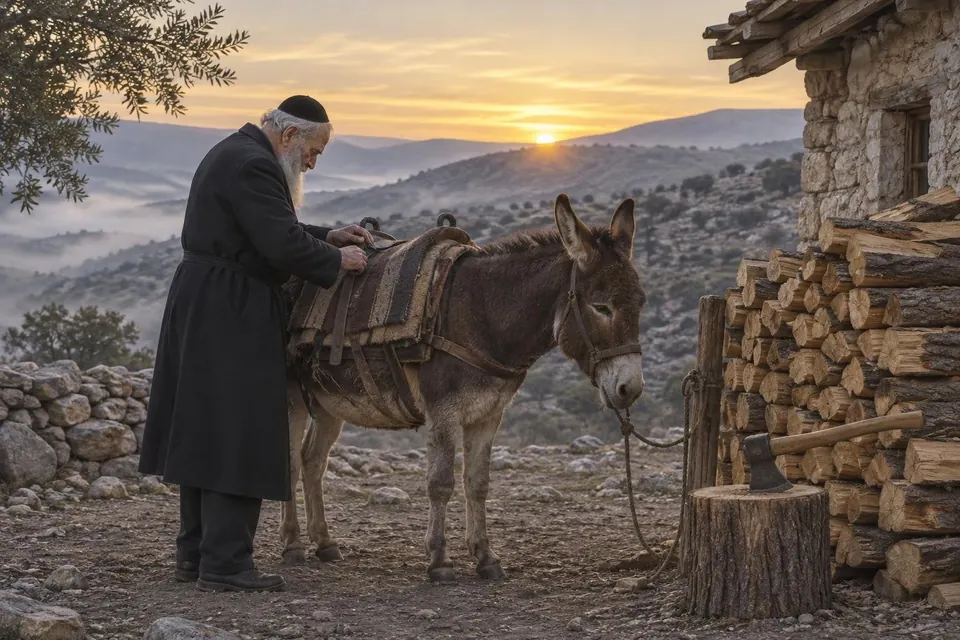
And this was not his first test. In the previous chapter, God commands him, “Leave your land, your birthplace, and your father’s house” [Genesis 12:1]. This was very difficult for our forefather Abraham. He had built his home in Haran. He had worked very hard to bring all the local people closer to God, and he still had much work ahead of him. Suddenly God tells him, “Go!” He promises Abraham that he will have an abundance of blessings in the new place. What does Abraham do? He asks no questions. Instead, immediately, “Abraham set out, as God had told him” [Genesis 12:4]. He immediately leaves everything behind and goes!
And that is not all. At last he comes to the land of Canaan, and for the first time in human history, a famine strikes the world. There is nothing to eat. Abraham could easily have complained to God: “Master of the universe, You told me, ‘Go to the land I will show you, and you will have blessing, success, and every good thing.’ But now that I’ve come here, I have nothing to eat. This has never happened before; it’s the first time there’s no food. What about Your promises, Almighty?” But he did not say a word!
And to this day, we live by the resounding silence of our holy forefathers!
By Rabbi Shimshon Pincus
Keep reading
More →Why Was Moses Punished for Hitting the Rock?
A teaching on Moses, Miriam, and the prayer for rain offers a different view of what happened at the rock.
ParashaWas Rachel Right to Give Leah the Signs?
Rachel’s sacrifice spared Leah from shame, but it raises difficult questions about Jacob and Leah.
Do We Really Know Who Abraham Was?
ParashaMiketz: The Danger of Perfection
Leah and Rachel, and Joseph and his brothers, embody different paths of serving God.







