Why Was Moses Punished for Hitting the Rock?
A teaching on Moses, Miriam, and the prayer for rain offers a different view of what happened at the rock.
In brief
- Maimonides says Moses' sin was his anger at the people, not his striking the rock.
- The prayer for rain mentions Moses striking the rock as a sign of his righteousness.
- One explanation is that Moses struck the rock to protect Miriam's honor.
- In the prayer for rain, we ask God to show us generosity as Moses did.
Parashat Chukat#
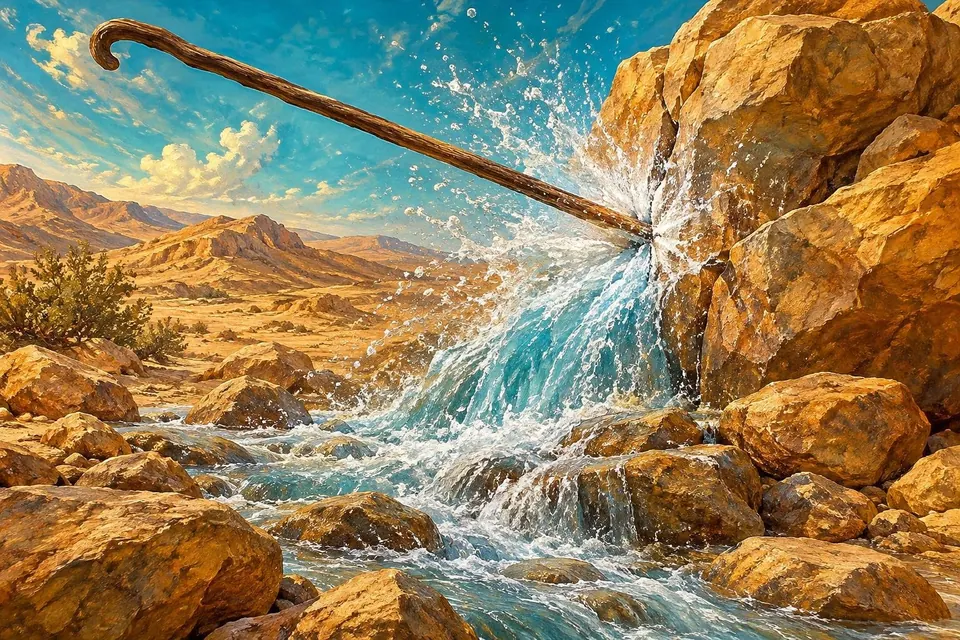
The Tzitz Eliezer cites the Gerrer Rebbe's explanation of Maimonides' view of Moses' offense at the waters of Meribah. Rashi and other commentators explain that Moses' offense was striking the rock instead of simply telling it to give water. Maimonides, in Shemonah Perakim (Eight Chapters), explains that Moses' sin was losing his temper at the behavior of the Israelites and rebuking them: “Listen now, you rebels” (Numbers 20:10). According to Maimonides, Moses' offense, and therefore his punishment, had nothing to do with striking the rock.
The Tzitz Eliezer cites the Gerrer Rebbe in support of Maimonides' approach, pointing to a passage in the prayer for rain (tefilat hageshem), which we recite on Shemini Atzeret. It says: “When the beloved people needed water, he struck the rock and water came out ... in the merit of this righteous act, abundant water came forth.” The Gerrer Rebbe challenges the other commentators: If striking the rock was a mistake, as Rashi says, why would the prayer for rain cite it as evidence of Moses' righteousness?
One could answer that the passage refers to the episode in Parashat Beshalach, when Moses was explicitly told to strike the rock. But since the prayer does not specify otherwise, it can be understood as referring to both episodes as acts credited to Moses.
The Tzitz Eliezer does not deny that God had not told Moses to strike the rock at Meribah. What, then, prompted him to do it? And what act of righteousness does the prayer for rain have in mind?
Recall that throughout the years of wandering in the wilderness, the people of Israel had water in Miriam's merit. Parashat Chukat tells us of Miriam's death and the disappearance of the miraculous well. Why, then, when the people desperately needed water once again, did God change His instruction to Moses, telling him to speak to the rock rather than strike it? Why was he told to strike the rock in Beshalach, but to speak to it in Chukat?
As we mentioned, the well originally traveled with the Israelite camp in Miriam's merit. Yet as great a prophet as Miriam was, she was not on Moses' level. This explains why the miracle performed in her merit was more natural. From our perspective, the distinction may not seem obvious, but in the Torah's terms, striking a rock to make water flow is a “lesser” miracle than telling it to give water.
Moses' greatness was evident in the more “supernatural” character of his miracles. His greater merit allowed him to draw water from the rock simply by telling it to flow, and that is precisely what God told him to do. Moses knew that all he had to do was speak to the rock. Even so, he thought that doing so might somehow diminish his sister's reputation: Her merit had not been as great, and water had flowed from the rock only after force was applied, by striking it.
Here we see another expression of Moses' unprecedented humility. He did not want to appear greater than his sister, so, out of righteousness and humility, he struck the rock. This is what we speak of in the prayer for rain.
Now the pieces come together. We turn to the Creator in the prayer for rain. We tell Him that we may be unworthy of such a great blessing, but that we desperately need it. We plead with God to go beyond the measure of justice, and we ask Him to remember what Moses did.
Moses could have spoken to the rock, and that would have been enough to bring forth water. But Moses “went beyond.” He did not want to gain honor for himself, and he wanted to preserve the memory of his sister as a great prophet, leaving no one any reason to doubt the greatness of her merit. It is in the merit of this generous act by Moses that we ask the Creator to be generous to us. That is why we mention the event at the waters of Meribah in the prayer for rain.
By Rabbi Yissocher Frand
Keep reading
More →Was Rachel Right to Give Leah the Signs?
Rachel’s sacrifice spared Leah from shame, but it raises difficult questions about Jacob and Leah.
Do We Really Know Who Abraham Was?
ParashaMiketz: The Danger of Perfection
Leah and Rachel, and Joseph and his brothers, embody different paths of serving God.
ParashaAbraham’s Greatest Test: The Power of Silence
A Midrash finds a special source of merit in Abraham’s silence when God commanded him to offer Isaac.







