Do We Really Know Who Abraham Was?
A story about a rebbe’s carriage raises a question about what it means to know Abraham.
In brief
- A young man in Tel Aviv tells Rabbi Yaakov Galinsky that he is not religious when asked about Abraham.
- A carriage driver says he knew a great rebbe, but remembers seeing only his horses.
- The Ramchal urges people to reflect on what made the forefathers so beloved to God.
- Following Abraham’s example can help a person come to know him, at least a little.
Parashat Eikev#
I’m a graduate of the Novardok yeshiva, and as you know, we don’t hesitate when there’s something to be done or said. Once, I was walking down a street in Tel Aviv when I saw a young man. Judging by his walk, his glasses, and his briefcase, he was an educated person. I went up to him and asked:
“Tell me, do you know who our forefather Abraham was?”
He straightened up proudly.
“Excuse me, I’m not religious!”
“But you’re Jewish, aren’t you?”
“Of course!”
“Then you should be ashamed! If I asked any Frenchman who Napoleon Bonaparte was, he’d answer me right away, because it’s part of his nation’s history. And you don’t know who founded your own nation? Is this the education Jews receive in the Jewish state?”
Now you’re smiling: Poor people! We, thank God, know who Abraham was. But what do we know? Do we know who our forefather Abraham was? Do we have any idea at all?
Let me tell you a story.
A righteous Jew named Reb Yossele Lifshitz lived in Bnei Brak. His whole life was filled with Torah and good deeds, and he was a Hasid of Stuchin. Once he said to me, “Come, let me tell you a story!” He knew that stories were my bread and butter, and he certainly knew how to tell one.
This is what he told me:
“Once, I was sitting at the table of my teacher, the Rebbe of Stuchin, Rabbi Yehuda Horowitz, author of Minchat Yehudah. He was speaking about his great-grandfather, the righteous Rebbe Moshe of Rozvadov. He was like an angel of the Almighty.
“Suddenly, one of those present, a simple Jewish carriage driver, said, ‘Yes, I knew him...’”
Everyone was shocked. Just imagine people sitting together, talking about the greatness of the Vilna Gaon. Then, out of nowhere, a simple Jew casually says, “Rabbi Elijah? Oh, yes, I know him.”
Everyone turned to the driver and begged him to tell them how he had met the rebbe, what he had heard from him, and what the rebbe looked like.
Oh, how he swelled with pride! He was so flattered by all the attention. Now everyone would know he was no ordinary Jew. He had been privileged to know the present rebbe’s great-grandfather!
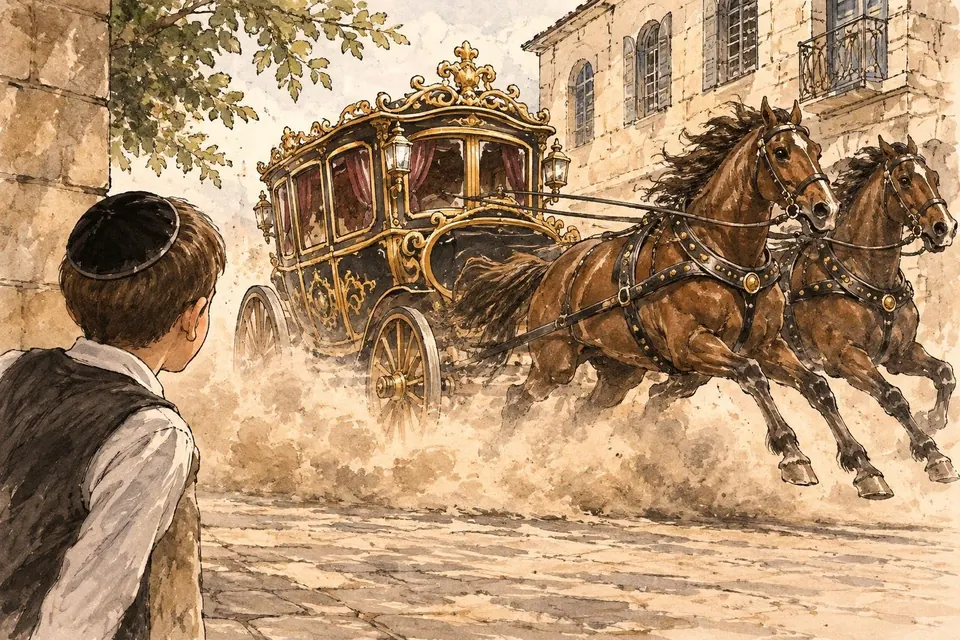
He settled comfortably into his chair and began to reminisce. “We lived in the town of Kielce. My father was a carriage driver too, and I was a child, studying in cheder (a Jewish school for young children). I remember it as if it were today. The rebbe—Rebbe Moshe of Rozvadov—was in the city of Reisha and was due to return home through our town. We were told that at four o’clock his carriage would pass along the main street.
“Everyone went out to welcome the rebbe. We children put on our Shabbat clothes, and we were given paper flags. To tell the truth, he was a little late. At about 4:30, we saw a cloud of dust in the distance: the rebbe was coming!
“The carriage came closer, drawn by two white horses, and traveled all the way down the main street on its way to Rozvadov...”
“And the rebbe?” his listeners asked impatiently.
“The rebbe was in the carriage, of course!”
“And did you see him?”
“No, I didn’t see him himself, but let me tell you—what horses!” That was how he had “known” the Rebbe of Rozvadov.
And I—shameful as it is to admit—can I really think that I knew the Chazon Ish? What did I know? His glasses and his beard, his gaze and his smile... But in truth, he was “in the carriage”! Did anyone really know him?
“If the sages of the earlier generations were like angels, then we are like human beings,” says the Talmud [Shabbat 112b]. If we were to see an angel, would we dare say that we knew him?
How much more is this true of our forefathers! Yet Rabbi Moshe Chaim Luzzatto (the Ramchal) writes: “...This is the best and most powerful remedy you could devise against the evil inclination. It is easy, very effective, and bears abundant fruit. A person should set aside all other thoughts for one hour each day and think only about this, asking in their heart: ‘What did our forefathers do that made them so beloved to God?’”
And it says this explicitly in Parashat Eikev: “To the Lord your God belong the heavens and the highest heavens, the earth and everything on it.” Yet out of all this, “the Lord loved only your forefathers. And He chose you, their descendants after them”—that is, those who follow in their ways—“from among all the peoples, as He does today” [Deuteronomy 10:14–15].
Whoever has made a habit of striving toward this and wishes to fulfill the obligation that “every person must say: When will my deeds reach the deeds of Abraham, Isaac, and Jacob?” (see Tanna Devei Eliyahu)—
- whoever tries to make Abraham’s quality of kindness their own;
- whoever tries to fulfill the words, “I have loved him because he will instruct his children and his descendants to follow the way of the Lord, doing righteousness and justice” [Genesis 18:19];
- whoever takes him as an example in standing firm through trials, “to make known how beloved our forefather Abraham was, peace be upon him” [Mishnah Avot 5:4];
- whoever wishes to acquire “a generous eye, a humble spirit, and a modest soul”—the qualities of Abraham’s disciples, “who enjoy this world and receive a share in the World to Come” [Mishnah Avot 5:19].
Such a person can say that they knew our forefather Abraham, at least a little!
By Rabbi Yaakov Galinsky
Keep reading
More →Why Was Moses Punished for Hitting the Rock?
A teaching on Moses, Miriam, and the prayer for rain offers a different view of what happened at the rock.
ParashaWas Rachel Right to Give Leah the Signs?
Rachel’s sacrifice spared Leah from shame, but it raises difficult questions about Jacob and Leah.
ParashaMiketz: The Danger of Perfection
Leah and Rachel, and Joseph and his brothers, embody different paths of serving God.
ParashaAbraham’s Greatest Test: The Power of Silence
A Midrash finds a special source of merit in Abraham’s silence when God commanded him to offer Isaac.







