What Does It Mean to Be Created in God’s Image?
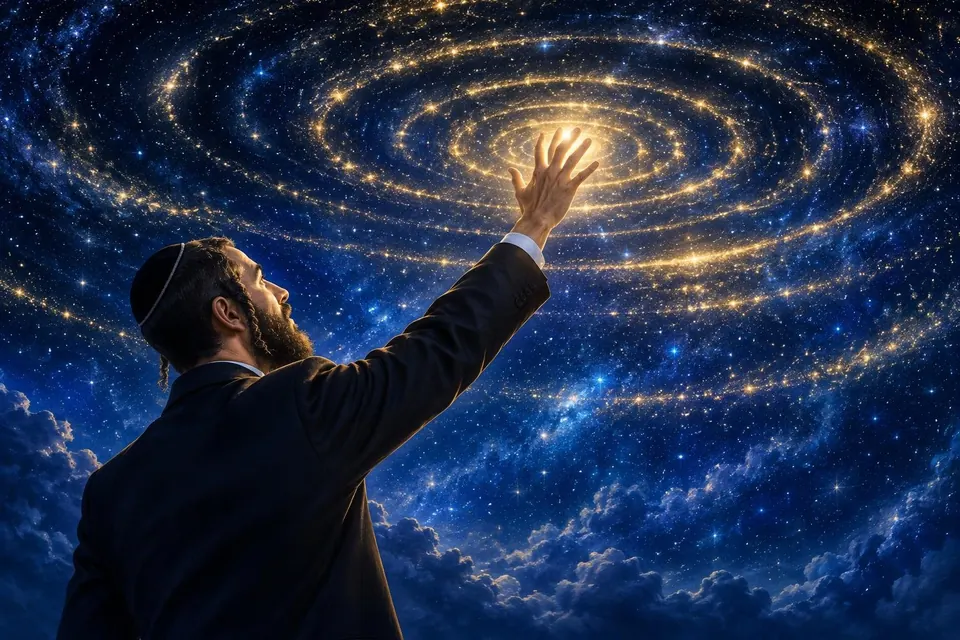
Rabbi Chaim of Volozhin explains how human actions reflect God’s power and affect the spiritual worlds.
In brief
- Being created in God’s image does not mean that God has a body or resembles a human being.
- God continually gives existence and power to every part of creation.
- God has made the vitality of spiritual worlds dependent on human actions, words, and thoughts.
- A person’s ability to affect those worlds comes from God, not from an independent power.
Parashat Bereishit#
We present an excerpt from Nefesh HaChaim by Rabbi Chaim of Volozhin, which explains that human beings were created in the image and likeness of God. This means that people have been given the ability to resemble the Creator through their actions, but not in their essence. The name of God Elokim means that He is the master of all the forces at work in the world. The world exists only because God continually sustains it. Every human action affects not only this world but also the higher spiritual worlds. This is how human beings resemble the Creator: They, too, have been given the power to create and give life to spiritual worlds.
Chapter 1#
Human beings were created in the image and likeness of God. This means that they have been given the ability to resemble the Creator through their actions.
It is written: “God (Elokim) created the human being in His image; in the image of God (Elokim) He created him” (Genesis 1:27). It is also written: “For in the image of God (Elokim) He made the human being” (Genesis 9:6). The full depth of the true meaning of tzelem (image) in this context is a great mystery. To understand it, one must understand much of the wisdom concealed in the Zohar. Here, we will explain tzelem following the early commentators, in keeping with the plain meaning of the verse: “Let us make the human being in our image, according to our likeness” (Genesis 1:26).
Clearly, the words tzelem, “image,” and demut, “likeness,” cannot be understood literally here. For it is written explicitly: “To whom, then, can you liken God?” (Isaiah 40:18).
It would, of course, be a grave mistake to say that the form of a human being living in the physical world resembles the form of God, who is above all things, God forbid. The Creator has no body, nor anything resembling a body. The only similarity between a human being and the Creator is that a person has been given the ability, in a certain sense, to act like the Creator. — Note by Rabbi A. D. Goldberg.
Rather, the words refer only to a similarity in some particular aspect or quality. Consider, for example, the verse: “I have become like an owl of the wilderness” (Psalms 102:6). The author, King David, certainly did not mean that he had grown wings or a beak like an owl. Nor did he mean that he had come to resemble one in appearance. The meaning is that his actions had become like those of the owl: He was forced to wander from place to place, like the owl of the wilderness, a solitary bird that constantly moves from one place to another. This is how the early commentators explained the plain meaning of the comparison [Maimonides, Guide for the Perplexed, 1:1; Nachmanides, commentary on Genesis 1:27]. The same applies to the word tzelem, “image”: A human being resembles Elokim in some way through their actions.
One of the Torah’s commandments is to “walk in God’s ways”—to act as God acts. At first glance, the obligation to resemble God concerns the expression of good character traits, as the Sages said: “Just as He is gracious, you too should be gracious” [Shabbat 133b].
But the Jerusalem Talmud says (Jerusalem Talmud, Rosh Hashanah 1:3): “In the way of the world, when a king issues a decree, he may choose to follow it or not. God is not so: He does not issue a decree until He Himself has begun to observe it.” It follows that all 613 commandments of the Torah reflect, first of all, actions that God performs. In these actions, a human being can resemble Him.
The Sages explain at the end of Makkot that the 613 commandments correspond precisely to the structure of the human body [Makkot 23b]. By fulfilling the 613 commandments, a person acts like the Creator. Thus, the resemblance between a person and the Creator does not lie in His having body parts like a human being, God forbid, but in a person’s ability to emulate the Creator’s actions.
For example, the Creator does good. When a person does good in this world, they resemble the Creator in that respect. The same applies to all 613 commandments. There is a correspondence between the Creator’s actions in governing the world and the fulfillment of the commandments in this world. — Based on a note by Rabbi Y. E. Weintraub.
Chapter 2#
The name of God Elokim means that He is the source of all the forces at work in the world. The world exists only because God continually sustains it.
We must now consider the expression “in the image of Elokim.” Why is this particular name of God used, rather than one of His other names? The name Elokim means that He, blessed be His name, is the master of all forces, as explained in the Tur (Orach Chaim 5). [These are the words of the Tur: When a person says one of God’s names in a blessing, they should have the following meanings in mind ... the name Elokim means that He is strong and powerful and has the ability to control the upper and lower worlds, for the word El means strength and power.]
To understand what it means that He is the “master of all forces,” consider that the deeds of flesh and blood are unlike the deeds of God. When a person builds a house, say, out of wood, the builder does not create or produce the wood. The builder uses material that already exists, arranging and placing it so that it becomes a house. Once the work is done and every part is fixed in place, the builder stops working and goes away, while the house remains standing on its own.
But when He, blessed be His name, created the worlds, He created them all from nothing. With His unlimited power, He brought them into being out of complete nonexistence. Ever since, He has continued to create everything anew, every day and every moment. Their entire order and existence depend on the flow of life and new light that is constantly renewed and sent down to creation from the Creator, blessed be His name, according to His will. If He, blessed be He, were to stop sending that life-giving power to creation for even one moment, everything in existence would immediately disappear and return to complete nonexistence.
This is why the members of the Great Assembly established the words of the morning prayer, in the first blessing before the Shema: “In His mercy, He renews the work of creation every day, constantly.” “Constantly” means exactly that: at every moment and every instant. The proof is in the words: “He who makes the great lights” (Psalms 136:7). It does not say “who made,” but “who makes” [continually].
The simple meaning of this verse is that the sun always shines. Even when it is not visible here, we know that it is shining somewhere else.
A deeper understanding is that light, as we experience it, gives us the closest picture of how the world exists. As soon as the source of light disappears, the light itself disappears. The same is true of the world: If the Creator’s will, which constantly renews the world, were to disappear, the world itself would disappear. — Note by Rabbi Y. E. Weintraub.
We do not perceive the constant renewal of the world. Its source lies in the four letters of the Creator’s hidden name, in their highest spiritual archetype, and in the four highest spiritual foundations, which are the spiritual roots and origins of creation. As the Zohar says (Vaera 23b), they are the roots of the entire universe and the inner essence of all creation. Their unions and combinations become the source of creation’s renewal at every moment and every instant. These changes are beyond comprehension, and He, blessed be His name, renews them at every moment according to His will.
The essence of their union at each moment consists of 1,080 combinations of the letters of the Creator’s name, blessed be He, with variations of all the vowel marks, which correspond to vowel letters in other languages. This corresponds to the division of an hour into 1,080 moments. Their combinations also change from hour to hour, and the combinations of the day are unlike those of the night. No two days are alike: Each day differs from the day before it and the day after it. This is what is meant by “renews” and by the words Maaseh Bereishit, “the work of creation.” — Author’s note.
This is why He, blessed be His name, is called Elokim, the master of all forces. He gives strength and power to all the forces at work in all the worlds. The existence of these forces and worlds depends entirely on Him. At every moment, He renews, apportions, and sends them a flow of strength and power. It is His will to change and rearrange them continually, as He desires.
[In the holy language, the word Elokim is used in two senses. First, it is one of God’s names. Second, it refers to a force or a holder of power at work in the world. For the first meaning, we will write “Elokim,” a slightly altered pronunciation of God’s holy name traditionally used to avoid accidentally pronouncing it in an inappropriate setting. For the second meaning, we will use “Elohim.”] Elohim is a collective term for all holders of power in the world. All rulers of the upper and lower worlds are called Elohim, as in “the gods of the nations” (Psalms 96:5), or “For all the peoples walk, each in the name of its god” (Micah 4:5). See the Zohar (Vayikra 8a; Balak 208a), which says that when Scripture speaks of God coming to Abimelech, Laban, or Balaam, it refers to the spiritual force that governs each of them. Even ordinary judges are called Elohim. See also the Zohar (Mishpatim 96b) [which explains that the flow of forces that gives life to the various parts of creation is called Elohim].
None of these forces, however, exists independently. They can exercise power only because He, blessed be His name, has given them strength and the ability to rule. He is therefore called (Psalms 136:2) *Elokei Elohim [literally, “God of forces”]. It is written: “God is greater than all gods” (Exodus 18:11), and “Let all gods bow down to Him” (Psalms 97:7). Even idol worshippers call Him, blessed be His name, Eloka deElohim, “God of gods” (Daniel 2:47). This is why they are called “the gods of others”: Their power does not come from themselves. They draw strength from a source above them, and that source, in turn, draws from a still higher source, and so on. Ultimately, they all draw from the one true Source of all forces, blessed be His name. Thus it is written: “God, Elokim, is truth” (Jeremiah 10:10), for He is the true, original source of all forces, while all other sources draw their strength only from Him. Scripture also says: “All the people saw and fell on their faces, and they said: ‘God, He is Elokim’” (1 Kings 18:39). — Author’s note.*
Later, in the third section, the author explains that the first idol worshippers did not believe that the stars or idols they worshipped had created the world. They believed that God created everything, including the objects of their worship. That is why they called God Elokei Elohim. Their mistake was to believe that God had given these stars and idols power and authority and then withdrawn from governing the world. They believed that these forces now ruled independently of His will, according to their own whims. This is wrong. Although God has given them certain abilities and authority, He Himself continues to govern the world without interruption and has not abandoned its governance for even a moment. Because the power held by the stars and other forces is not independent but comes from the Creator, no force other than Him may be worshipped, blessed be His name. — Note by Rabbi A. D. Goldberg.
Chapter 3#
Every human action affects not only this world but also the higher spiritual worlds.
Here is how a human being resembles, in a certain sense, [the manifestation of God corresponding to the name] Elokim: The Creator made people capable of exercising authority over a vast multitude of forces and countless worlds. Human beings have been given power to govern the worlds. Every detail of their actions, words, and thoughts, even the most seemingly insignificant one, and every movement affects the higher spiritual worlds, for good or, God forbid, otherwise.
In other words, people have been given authority to govern the world at the level of the spiritual roots from which it comes. Everything that happens in the world depends on how people affect those roots. Thus, human beings govern everything that happens in the world. — Note by Rabbi A. D. Goldberg.
Through every good action, word, and thought, a person sustains and strengthens many higher, holy worlds and forces, increasing their holiness and light. As it is written: “I have placed My words in your mouth and sheltered you in the shadow of My hand, to establish the heavens and lay the foundations of the earth” (Isaiah 51:16). And the Sages said (Berakhot 64a), commenting on the verse “All your children will be taught by God, and great will be the peace of your children” (Isaiah 54:13): “Do not read banayich, ‘your children’; read bonayich, ‘your builders.’” For they [those who study Torah] build the higher worlds and strengthen them with great power, like a builder raising a building.
Conversely, God forbid, through sinful actions, words, or thoughts, a person destroys countless great and holy higher worlds and forces, as it is written: “Your destroyers and those who laid you waste will depart from you” (Isaiah 49:17). Or, at the very least, a person diminishes and obscures the radiance of their holiness, God forbid, and gives power to the impure forces of darkness.
Here the author lists three kinds of harmful effects on the higher worlds: destruction, diminution, and obscuring their radiance. These correspond to different levels of worlds. The higher the world, the less susceptible it is to human influence. Thus, in lower worlds sin causes destruction; in higher worlds, diminution; and in still higher worlds, it can only partially obscure their radiance. — Note by Rabbi Y. E. Weintraub.
In chapter 12, the author explains that the very existence and life of the forces of evil result from the destruction that sin causes in the holy worlds. — Note by Rabbi A. D. Goldberg.
This is the meaning of “Elokim created the human being in His image” (Genesis 1:27), and “for in the image of Elokim He made the human being” (Genesis 9:6). Just as He, blessed be His name, is Elokim—the master of all the forces that exist in all the worlds, their sole governor and ruler—so He has, according to His will, given human beings authority over a vast multitude of spiritual worlds and forces. The keys are now in human hands to give life to these forces and worlds by directing a flow of life into them, or, conversely, to bring about their death.
This process is constant. There is not a single moment in a person’s life when their conduct and every detail of their actions do not affect the vitality of the higher worlds and forces. Every action, word, and thought affects the higher worlds according to the level of its spiritual source. It is as though the person rules over the worlds, and in this they resemble Elokim.
A person’s actions affect the higher worlds not only when they study Torah or fulfill mitzvot. Every action and movement, and every detail of them, however small, has a constructive or destructive effect on the higher worlds. The reason is that no human action is neutral. Every act has the character of either a mitzvah or a sin. — Note by Rabbi A. D. Goldberg.
Here and elsewhere, the author makes clear that people cannot give life to the worlds or influence them through their own power. God Himself constantly gives life to and renews His creation. Human beings resemble the Master of the worlds because the Creator has made the vitality and order that He continually sends to the worlds dependent on human actions. Thus, people govern the worlds, even though their power to affect them does not come from themselves. — Note by Rabbi A. D. Goldberg.
Because the purpose of a person’s creation is to serve the Creator, and this is the whole of their essence, we cannot say that a person exists and, in addition, must serve the Creator. The whole essence and meaning of a person’s life is service of the Creator. Every act and movement can therefore either be directed toward serving the Creator or conflict with that service. There is no middle ground. Every action is thus either a mitzvah or a transgression. Nothing can be outside the service of God without being a sin.
When certain things are called “permitted,” this means that their status is determined by the intention with which they are done. If they are done in order to serve the Creator better, they become a mitzvah; if they are done for any other purpose, they become a sin. Things we call “mitzvot,” such as putting on tefillin, are actions that are always performed only for the purpose of serving the Creator. Things called “forbidden” are those that always conflict with the Creator’s will.
This is the meaning of the commandment “Know Him in all your ways” [Proverbs 3:6]: A person should use everything permitted to them in the service of the Creator. — Note by Rabbi Y. E. Weintraub.
The Sages said (Eichah Rabbah, on Lamentations 1:6): “Rabbi Azaryah said in the name of Rabbi Yehudah bar Simon: When Israel does the will of the Omnipresent, they increase the strength and power of the influence that God sends into the world, as it is said: ‘With Elokim we will grow strong’ (Psalms 60:12). But when Israel does not do the will of the Omnipresent, they, as it were, weaken His great influence, as it is written: ‘You weakened the Rock who gave birth to you’” (Deuteronomy 32:18).
The Zohar also says in several places that the sins a person commits cause a blemish in the higher spiritual worlds, and the reverse is also true. This is the meaning of the verse “Give strength to Elokim” (Psalms 68:34). And the Zohar says at the beginning of the portion of Bo, based on Job 1:6: “‘A day came when the sons of God came to stand before God’—another reading is ‘they rose against God.’ When the forces of evil wish to accuse a Jew of improper conduct, they certainly stand against God to bring their accusation. For when a Jew acts improperly, this, as it were, weakens the flow of life with which God sustains creation. When a Jew acts well, it, as it were, strengthens the flow that comes down from God to creation. This is what is meant by ‘Give strength to Elokim.’ How [can one give strength to Elokim]? Through conduct pleasing to God.”
This is why it says “to Elokim,” and why it also says, “We will strengthen Elokim” (Psalms 60:12). As explained, the word Elokim means the master of all forces, [whose power to influence God has made dependent on human actions].
As noted above, sin damages all the worlds. But the damage is not of the same magnitude in every world. In our world, sin can lead to complete destruction. An example is the destruction of the Temple and the exile of the Jewish people. In higher worlds, the damage takes the form of an obscuring of the radiance that reaches them. In still higher worlds, the damage makes the world less than perfect.
On the other hand, sin brings about and strengthens worlds of darkness, in which the forces of evil rule. The greater the damage to the holy worlds, the more the worlds of evil grow. — Based on a note by Rabbi Y. E. Weintraub.
We have said that human beings have been given authority over the worlds. It should be noted that not everyone is given the same degree of authority. The kinds of influence, as well as their extent and quality, differ from person to person. Everything depends on the role assigned to a person in life. In an earthly kingdom, if a soldier fails to report to their post, it slightly diminishes the king’s honor. But if the commander in chief fails to appear at their post, it is a terrible affront to the crown. So, too, there are differences among people. Everyone has the ability to increase or diminish God’s glory, but people do not have equal capacities. Only on the day of the Great Judgment will a person learn what role they were meant to play in life. — Note by Rabbi Y. E. Weintraub.
Keep reading
More →Acharei Mot–Kedoshim: The Advice of a True Doctor
A Torah perspective on medical advice, hope, prayer, and the difficult work of giving and receiving warnings.
ParashaShelach: True Greatness Is Not Arrogance
The spies’ report offers a lesson in self-confidence, dignity, and humility.
ParashaChukat: Transition Periods in Life
Rabbi Yissocher Frand explores why times of change call for special care toward ourselves and our families.
ParashaChukat: Appreciate Your Loved Ones
The Song of the Well offers a lesson about recognizing the people we take for granted.







