Free Will and the First Mitzvah
The mitzvah of marking the new month offers a way to understand the freedom to turn toward God.
In brief
- The first mitzvah given to Israel was to mark the new month.
- Human beings have the freedom to choose the direction of their lives.
- Turning toward God is compared to the beginning of the new moon.
- That first turn must be followed by a lasting bond with God.
“This month shall be for you the beginning of the months” (Exodus 12:2).
The First Mitzvah#
The mitzvah to count the new months was the first mitzvah given to the people of Israel, as Rashi says in his commentary at the beginning of Genesis (Rashi on Genesis 1:1). A beginning is generally the foundation and leading part of what follows it.
Let us consider what is so special and fundamental about the mitzvah, “This month shall be for you.” Why did this mitzvah come before the entire experience of the Exodus from Egypt, and why is it the root of all the mitzvot that followed?
Connection to God#
We have already discussed at some length, in the talk “The Exodus From Egypt: The Birth of the People of Israel,” how the enslavement in Egypt was like the pregnancy of the people of Israel, and the Exodus was like their birth. Every year, when Passover comes, we too must be born again, so to speak, and become new people.
What does it mean to be human?
First, we should recognize that the “scientific” definition of a human being is completely inadequate. Scientists maintain that a human being is merely an animal with a highly developed brain. This is a mistake. A human being is not an intelligent animal but a fundamentally different creature, different from an animal in essence.
The essence of a human being lies in one thing alone: a person is a creature capable of connecting with God.
How can we connect with God? Naturally, by thinking about Him constantly, as Maimonides (the Rambam) wrote in The Guide for the Perplexed (3:51): “The intellect that God has given us is the bond between us and Him.” And especially by speaking with God, because conversation creates connection. How can we speak with the Creator? Through Torah or prayer. This is the human being’s “living soul,” the “speaking spirit,” as Targum Onkelos, the Aramaic translation of the Torah, renders it (Genesis 2:7). The holy Zohar says that this refers to Torah study and prayer. By speaking with God through Torah and prayer, a person becomes a “living soul.”
This is the true reality of a human being.
Absolute Freedom of Choice#
If we look more deeply, we see that what defines a human being is, in essence, freedom of choice.
We usually think of “choice” as choosing yes or no: for example, whether to study Torah or waste time. Yes, that too is part of choice, but it is not the main part. There is a deeper level of choice that is true choice. Our holy books call it daat (awareness) or hachraa (decision).
Before reading the haftarah (the reading from the Prophets), we say the blessing, “Blessed are You ... who chose good prophets.” This does not mean that God, heaven forbid, was uncertain whether to rest His Shechinah (Divine Presence) on good prophets or bad ones and chose the good. Similarly, when we say, “You chose us from among all peoples,” it does not mean that there was uncertainty between the people of Israel and other peoples. Rather, this choice is absolute. God’s absolute choice is the good prophets and the people of Israel.
In the same way, a person has been given freedom of choice and can decide with absolute freedom who they are and what they want from life. We will explain this further on.
Today, if a child in a family fights with and hurts others, the mother rushes to take him to a psychologist for assessment and treatment, so that the psychologist can diagnose why her son is aggressive. And what do modern psychologists say? “The child is not at fault. When he was little, he was treated in a way that caused him to develop aggression. An emotional wound inflicted in childhood is showing itself now.”
“Well,” says the mother, “in that case, it’s my fault.”
“No,” the psychologist replies, “you’re not at fault.”
“Then who is?”
“Your parents!”
According to this psychological approach, no one is at fault, because a person is a chain of reactions. Every reaction has a cause, that cause has its own cause, and there is no first cause. It follows that a person is not responsible or to blame for their actions. According to this approach, a human being is really a highly sophisticated computer, operating according to the data fed into it. This is the widespread approach today: a human being is an animal with intelligence.
What is the approach of our holy Torah?
True, there are “chain reactions,” but at the first point there is a power called “freedom of choice,” and it is absolute and independent of everything else.
God gives a person the power to choose, and the person chooses between good and evil. This cannot be understood or grasped, because it is a point of the Divine. A person makes a choice with absolute freedom. It is not a “chain reaction,” but the essence of a human being.
Turning to God: The Point of Birth#
This idea, in all its depth, appears in the Torah in the passage, “This month shall be for you ...”
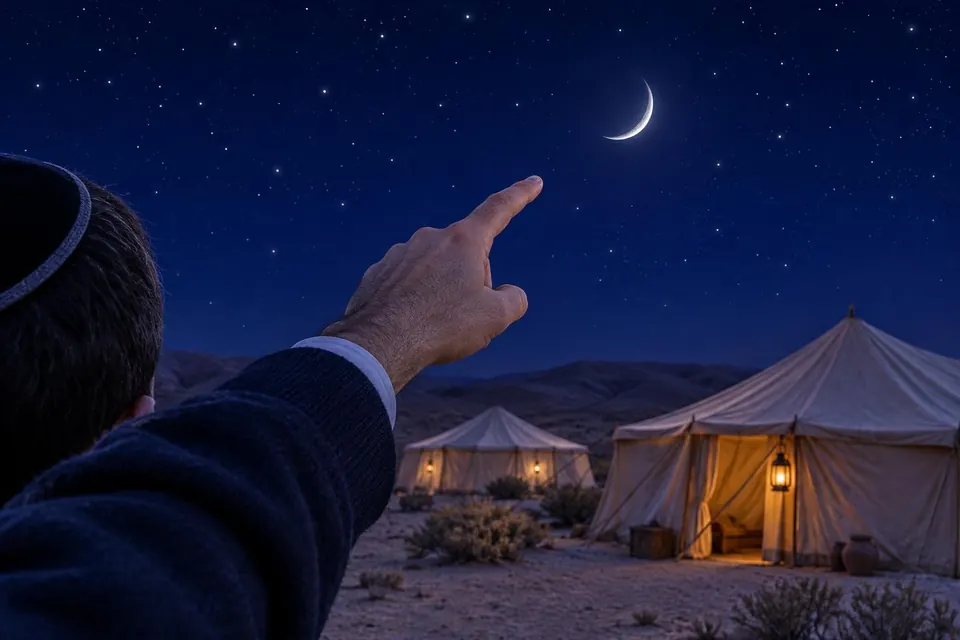
The moon is compared to the people of Israel, while the sun is understood to symbolize God: just as the moon receives its light from the sun, the people of Israel receive theirs from God. The moon’s first connection with the sun is that it turns toward the sun and receives its light. This is the birth of the new month, the new moon, or Rosh Chodesh.
The same is true of the people of Israel and God. When a Jew turns toward God, that is the point of birth, which is also the point of choice. It is a deep, Divine point, something from nothing, the image and likeness of God. It is so subtle that no one in the world sees or senses it, yet within it lies the reality called a “human being.” Everything begins there: “This month shall be for you ...”
A person has two possibilities: to choose God or, heaven forbid, idolatry. We know what it means to choose the Creator, but what does it mean to choose idolatry?
Imagine asking an ordinary person what the meaning of their life is and what they want from it. They answer, “I want a comfortable life, without pain, suffering, or debt. I want my children to bring me joy, and I want to live a good, peaceful life.” Although there seems to be nothing objectionable in these desires, our Sages say of this: “Let there be no foreign god within you, and do not bow to an alien god” (Shabbat 105b). What foreign god is in a person’s body? The evil inclination. If a person defines their life by the pursuit of pleasures, however kosher those pleasures may be, that is idolatry, because the person’s “self” is their evil inclination.
A person must choose to make connection with God what defines their life.
The physical point responsible for this choice is at the top of a person’s head, where the brain is, in the place where tefillin are worn. The tefillin that adorn the top of the head symbolize that a person’s deepest essence is connection with God.
This is what a human being is: connecting one’s first point to God. This is closeness and connection with Him, and it is hinted at in the verse, “This month shall be for you.”
In other words, that first choice is called the “firstborn,” because a person must decide what to put first. The people of Israel were born at the moment of the plague of the firstborn, because we received this original point of choice, the point of our “self,” at the Exodus from Egypt.
Serving God With the Mind#
We place tefillin on the head, opposite the brain. Those who reject the faith and do not believe in the Oral Torah place them between their eyes, and there is a very subtle difference here.
Some people seem to choose God all their lives, but it is not a choice of their “firstborn” or their “self,” because they seek God not with their heads but with their eyes.
These people want a pleasant, comfortable life. How can they attain it? They understand that this wonderful world has a Master, and that He will punish them if they disobey His will. So they study Torah and pray to God because He is the great Master, and they understand that they will never have wealth, health, or any other success without Him. As in the familiar song mothers used to sing to their children, “Torah is the best merchandise,” they study Torah because it is good merchandise.
Someone who places tefillin between the eyes seems to declare that they can see with their eyes that closeness to God is very good. But using tefillin to feel good is not yet Judaism.
The deepest essence of a Jew is expressed in choosing God, as it says, “Choose life” [Deuteronomy 30:19]. Tefillin on the head, the place of the brain and the mind, show that a person has come to understand that they want to be with God because He is life itself, and that they offer their inner “ego” to the Creator.
The New Moon: Turning to God#
This is the principle contained in the mitzvah, “This month shall be for you ...” At the very beginning of a person’s life, they must decide what they truly want and which way they are going. This is a very subtle and difficult moment, but it is the beginning of everything.
That is what we learn from the beginning of the month. By giving us the mitzvah to sanctify the beginning of the month, God hints to us that, of course, at the beginning of the month we have almost nothing, like the moon, which is barely visible at that time. But all we need to do is turn toward God, who is compared to the sun. Some may dismiss this turn because it is so tiny, almost imperceptible. But if we make it, it is only a matter of time before great and important things grow from it. In 15 days, when the moon is full, we will leave Egypt with the help of His mighty hand, or sit in a sukkah with the Creator.
But we must also know something else: even when the moon is already full, when we have already eaten matzah and maror (bitter herbs) and sat in the sukkah, if we turn away from God, as the moon turns away from the sun, in two weeks we will become nothing again.
A person’s condition today does not determine their entire life.
Even if a person is nothing now, as soon as they turn in the right direction, they will keep growing, like the moon. Today, nothing; tomorrow, a quarter moon; then a half moon; then a full moon.
On the other hand, even a person who has attained genuine perfection may feel satisfied and say, “Well, I need to enjoy this world a little too.” That is already a tiny turn of the back toward the Creator. It is then only a matter of time before the person falls from their high level, like the moon, which wanes from full to nothing in two weeks.
This is the first mitzvah: turn toward God. That is why sanctifying the month, which directs us to do this, is the mitzvah God gave the people of Israel before all others.
This idea is also emphasized in the wording of the verse. It says, “This month shall be for you”—specifically “for you”—because here it is you who must choose which way to turn.
Turning Toward the Creator#
To understand this idea more deeply, let us try to understand what it means to “turn toward God.”
This turn is the deepest point in a person, the point of pleasure. Rabbi Moshe Chaim Luzzatto (the Ramchal) writes in Mesillat Yesharim (The Path of the Just) that “a person was created for nothing other than pleasure” [Mesillat Yesharim, chapter 1]. But he immediately goes on to explain that a person has two possibilities and must choose whether they wish to “enjoy closeness to the Creator, which is true and great pleasure,” or whether, heaven forbid, their desire is “to take pleasure in material passions and desires, and if they follow them, they will move further and further away from true good.”
So what defines our “turn” is where we seek pleasure and enjoyment: in the house of study or, heaven forbid, outside its walls. Someone who says, “Of course I turn to the Creator, but not for pleasure—I sacrifice myself!” has not yet truly turned toward God.
The constant search for an opportunity to enjoy closeness to the Creator, to feel that “His palate is sweetness itself, and He is altogether desirable” (Song of Songs 5:16), is the genuine “turn” toward God. This is a very deep point of choice, in which lies the entire difference between the “firstborn of Egypt” and the “firstborn of the people of Israel.” This is the first point of Passover: “Consecrate every firstborn to Me” [Exodus 13:2].
Binding Ourselves to God: The Tenth of the Month#
We have spoken about turning toward God. But turning alone is not enough. We must continue on the path.
How is this done?
The renewal of the moon, the new moon, is birth. But the creation of a person or of the Jewish people is a process.
God commands: “On the tenth of this month, each man shall take a lamb for his father’s house, a lamb for each household” [Exodus 12:3]. This is no easy matter. The lamb is a symbol of the Jewish people. And here a Jew is told to take a lamb—that is, a Jew—and bind it. Why? Because it is not enough to turn toward God at the beginning of the month, at the new moon, and then walk about freely. We must be “bound” to God at every moment, at all times.
This “binding” is not done immediately after turning toward Him, but only after 10 days. Still, this is the direction we must take. We must be connected to God by a strong bond, turning neither right nor left.
By Rabbi Shimshon Pincus
Keep reading
More →Acharei Mot–Kedoshim: The Advice of a True Doctor
A Torah perspective on medical advice, hope, prayer, and the difficult work of giving and receiving warnings.
ParashaShelach: True Greatness Is Not Arrogance
The spies’ report offers a lesson in self-confidence, dignity, and humility.
ParashaChukat: Transition Periods in Life
Rabbi Yissocher Frand explores why times of change call for special care toward ourselves and our families.
ParashaChukat: Appreciate Your Loved Ones
The Song of the Well offers a lesson about recognizing the people we take for granted.







