Why Did Isaac Want to Bless Esau Instead of Jacob?
A closer reading of Isaac’s blessings suggests a plan for partnership between his sons.
In brief
- The childhood explanation that Esau deceived Isaac raises further questions.
- One explanation is that Isaac intended Esau to provide materially for Jacob.
- Rebecca knew Esau would keep the wealth for himself.
- Isaac intended the blessing of Abraham for Jacob from the start.
Parashat Toldot#
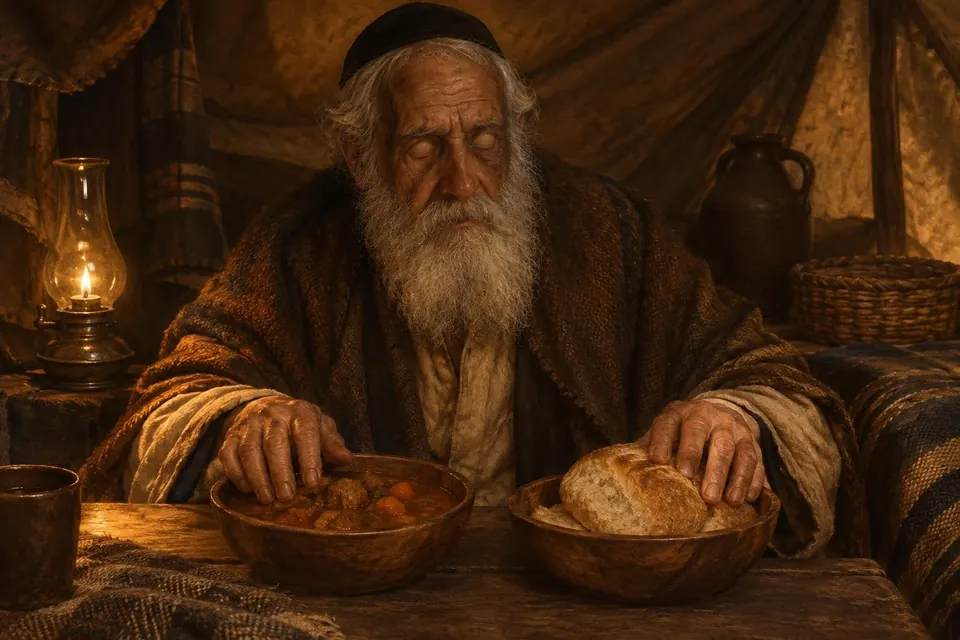
The most difficult and painful question raised by this week’s Torah portion is: Why did our forefather Isaac want to give the blessings to Esau rather than Jacob?
Before examining the question in detail, let us begin with a brief introduction.
- Some people treat questions and puzzling passages in the Torah as problems to be disposed of immediately. They offer an answer—any answer, right or wrong—just to relieve themselves of the burden of the question. But a wise person would understand that every question and every problem is a great gift. Our first understanding of a subject—whether a passage in the Torah, a topic in the Mishnah or Talmud, or a matter of mussar (ethical teaching)—may be mistaken. A question, or several questions, can help us discover new ways to understand it.
- In the third chapter of the section Cheshbon Hanefesh (self-examination) in Chovot HaLevavot (Duties of the Heart), Rabbeinu Bachya ibn Pakuda writes:
The twenty-fourth [kind of self-examination] concerns everything a person has learned and absorbed about God and His Torah, the words of the Sages of earlier generations, their puzzling [Midrashic teachings], and everything connected with prayer—all that they learned in their youth, as they grew and began to study. A person whose understanding is not yet strong does not grasp subtle matters in the same way as one who has gained wisdom. As the mind grows stronger, the understanding of these matters becomes clearer.
Therefore, do not rest content with what became fixed in your heart when you first studied those areas that involve doubt or require deep thought. Once your mind and understanding have grown stronger, begin to read the books of the Divine Torah and the Prophets as someone who has never studied them before. Train yourself to interpret and explain them, and to examine their words, language, and content closely. [Consider] what can and cannot be understood and accepted according to its plain meaning; what is revealed and what is hidden in them; and which passages have parallels elsewhere in Scripture and which do not.
When we were children, we were taught that Isaac wanted to give the blessings to Esau because Esau deceived him by pretending to be righteous. He asked his father how to separate maaser (a tithe) from hay. This is how Rashi explains the words “Isaac loved Esau, because he had a taste for game” (Genesis 25:28): Esau deceived, or “trapped,” his father with his mouth (Rashi on Genesis 25:28). But when we follow Rabbeinu Bachya’s advice and try to study the Five Books of Moses afresh, many questions arise about what we learned in our youth.
First, did Isaac not possess ruach hakodesh (holy spirit)? Even 400 or 200 years ago, righteous people were known to possess it and could foresee things. Could our forefather Isaac have been less than those righteous people? More than that, Isaac was a prophet, a level far higher than possessing ruach hakodesh.
Second, suppose Isaac really did consider Esau righteous. No one doubted that Jacob was righteous. Why, then, did Isaac want to give Esau everything? We know that was his intention because when Esau asked his father to bless him too, Isaac replied, “I have made him master over you” (Genesis 27:37). In other words, nothing remained. Isaac’s decision cannot be explained by the fact that Esau was the firstborn. A firstborn receives only twice as much as the others, not everything.
I would like to share an explanation I heard from my father, a great Torah scholar—may his years be long. It is based in part on the commentary of the Netziv of Volozhin.
Isaac, of course, knew who Esau was. But he thought that since Esau was “a man of the field” (Genesis 25:27), he should give him a full blessing for success in this world. Esau would then be able to provide everything his brother Jacob needed while Jacob devoted himself to Torah and service of God.
We might also suggest that Isaac thought Jacob should not receive a blessing for this world. If he did, when would he have time to study Torah? Recall the approach of Rabbi Shimon bar Yochai: If a person plows at plowing time, sows at sowing time, and harvests at harvest time, when will they study Torah? [Berakhot 35b]
This interpretation explains the whole matter. If we look closely at the blessing beginning “May God give you” (Genesis 27:28–29), which Isaac gave Jacob, we see that it speaks only of matters belonging to this world. Isaac therefore intended this blessing for Esau, not Jacob, and Esau’s success would benefit Jacob’s material well-being as well.
Interestingly, Jacob himself blessed two of his sons, Issachar and Zebulun, with such a spiritual and material partnership.
Rebecca opposed Isaac’s plan, however, because she knew that Esau would not serve Jacob but would simply keep all the wealth for himself. We might also add that Rebecca knew that among Jacob’s descendants there would be people better suited to the affairs of this world, who would use its blessings to support Torah and good deeds.
This explanation also clarifies why, at the end of our portion, Isaac gives Jacob another blessing (Genesis 28:3–4): “May God Almighty bless you, make you fruitful, and multiply you, so that you become a multitude of peoples. May He give you the blessing of Abraham, to you and your descendants with you, so that you may inherit the land where you live as a stranger, which God gave to Abraham.”
Isaac had intended this blessing for Jacob alone from the outset. It speaks of the spiritual side of life, including the inheritance of the Land of Israel, which could not apply to Esau.
By Rabbi Avraham Kuperman
Keep reading
More →Acharei Mot–Kedoshim: The Advice of a True Doctor
A Torah perspective on medical advice, hope, prayer, and the difficult work of giving and receiving warnings.
ParashaShelach: True Greatness Is Not Arrogance
The spies’ report offers a lesson in self-confidence, dignity, and humility.
ParashaChukat: Transition Periods in Life
Rabbi Yissocher Frand explores why times of change call for special care toward ourselves and our families.
ParashaChukat: Appreciate Your Loved Ones
The Song of the Well offers a lesson about recognizing the people we take for granted.







