Why Did the Israelites Crave Fish Instead of Manna?
Rabbi Yaakov Galinsky reflects on what our desires reveal about our spiritual lives.
In brief
- The Israelites remembered the foods they had eaten in Egypt and complained about the manna.
- A person’s desires can reflect their spiritual priorities and circumstances.
- Manna could take on different flavors, but people could choose whether to dwell on those flavors or on Torah.
- The Israelites’ longing for food raises a question about what interests us and what we strive for.
Parashat Behaalotecha#
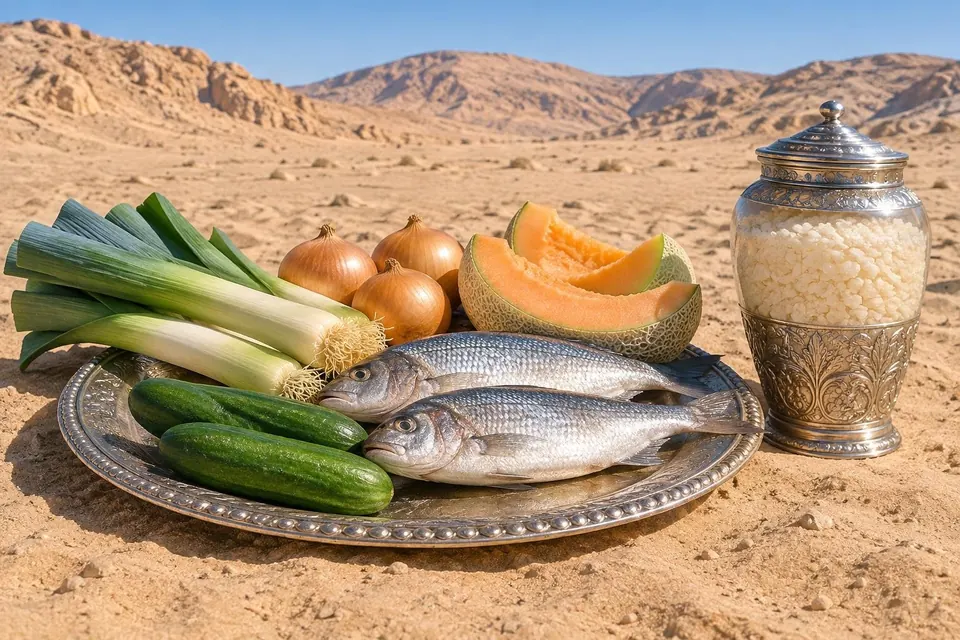
“The mixed multitude among them began to crave food, and the Israelites wept again and said, ‘Who will give us meat to eat? We remember the fish we ate in Egypt for free, the cucumbers and melons, the leeks, onions, and garlic. But now our soul is dried up. There is nothing at all; our eyes see only manna!’” (Numbers 11:4–6)
In Novardok, they used to tell a story: A yeshiva student climbs into a wagon that will take him to his yeshiva. What is he thinking about? What is the driver thinking about? And what is the horse thinking about?
The young man is thinking about the spiritual growth that awaits him at the yeshiva, about building and finding his own path in Torah. “Great is Torah, for it gives life to those who engage in it, in this world and in the World to Come” (Mishnah Avot 6:7). He hopes to grow more and more in Torah.
The driver is thinking about the fare he will receive and the food and clothing he can buy with it for his family. He hopes he will remain healthy and able to earn a living, and that, God forbid, his livelihood will not be cut off.
And the horse? The horse thinks about just one thing: returning to the stable in the evening and burying its head in a pile of oats. Its only prayer is that the driver will not whip it too often or too hard …
What does this story teach? The greater a person is, the higher they have risen spiritually, the greater and loftier their outlook and their desires.
A ben Torah (a person devoted to Torah) aspires to live by its light and grow spiritually. The driver thinks about earning enough, while the horse thinks only about a bag of oats and hopes not to be beaten too hard.
The Chafetz Chaim told of how the Russian czar was mocked and starved after he was overthrown and arrested. Newspapers gleefully reported that he had asked his jailers for two more potatoes a day. What a contrast to the luxurious life of physical pleasures he had known at the royal court. Tell me what you dream about, and I will tell you what situation you are in …
The sage Rabbi Chaim Brim once asked the Chazon Ish for advice on overcoming his love of food. That was what concerned a ben Torah at the time. The Chazon Ish told him, “I have no advice. But, you know, I can’t believe that the author of Ketzot HaChoshen (a work of Jewish legal commentary) took pleasure in a casserole!” His Torah is so sweet that everything else pales in comparison and loses its importance.
The author of Chidushei HaRim (a collection of Torah insights) explained the verse: “God said to Moses, ‘I will rain down bread from heaven for you. The people shall go out and gather each day’s portion on that day. In this way I will test them, to see whether they will follow My Torah or not’” (Exodus 16:4).
We know that manna could take on any flavor, depending on what a person wanted.
How wonderful! You could spend the whole day on it! Let’s see. A person says the blessing, “Who brings forth bread from heaven” (the blessing said over manna), and takes a taste. Ah, delicious! “Like a wafer made with honey” (see Berakhot 57b).
Now let’s imagine the taste of chocolate and vanilla ice cream. Dairy, of course. How delicious! Now let’s make it even better: chocolate with walnuts, and vanilla with cherries. Wonderful! Now let’s turn the vanilla into banana … Mmm … not so good. Let’s add some candied nuts. Not bad, but let’s go back to vanilla. Maybe add pistachios? …
Oh dear, what a thing to occupy your mind!
The author of Ketzot HaChoshen did not give it a moment’s thought. He ate, was satisfied, said the blessing after eating, and went back to his studies, because Torah was sweeter to him than honey and nectar!
“I will test them …” I will see what is on their minds. “Whether they will follow My Torah …” Will their minds be on Torah or on all the different flavors of manna?
Do you know what the very first lesson in mussar (ethical teaching) was?
“Where are you?” A whole speech in just two words! But what a world of meaning they contain …
“God called to the man and said to him, ‘Where are you?’” (Genesis 3:9). Midrash Rabbah comments: What have you become? Yesterday you listened to Me, and today you listen to the snake? Yesterday you stretched from one end of the world to the other (see Sanhedrin 38b), and now you have hidden “among the trees of the garden” (Genesis 3:8)?
Before the sin, the man gave names to all that was created. He understood the essence and purpose of every living creature! And now his entire spiritual stature had shrunk to the size of a tree; all that interested him was its fruit? How could he have made himself so small!
The Generation of Knowledge, the generation that received the Torah, is concerned with “Who will give us meat to eat?” All their weeping is over “We remember the fish”? Onions and garlic? Is it any wonder that “God’s anger flared greatly, and Moses was distressed” [Numbers 11:10]?
What about us? What interests us?
What do we strive for, and what do we remember?
By Rabbi Yaakov Galinsky
Keep reading
More →Acharei Mot–Kedoshim: The Advice of a True Doctor
A Torah perspective on medical advice, hope, prayer, and the difficult work of giving and receiving warnings.
ParashaShelach: True Greatness Is Not Arrogance
The spies’ report offers a lesson in self-confidence, dignity, and humility.
ParashaChukat: Transition Periods in Life
Rabbi Yissocher Frand explores why times of change call for special care toward ourselves and our families.
ParashaChukat: Appreciate Your Loved Ones
The Song of the Well offers a lesson about recognizing the people we take for granted.







