Ki Tavo: Gratitude and Not Being Ungrateful
The mitzvah of bringing first fruits teaches a lesson about expressing gratitude to God.
In brief
- Ki Tavo begins with the mitzvah of bringing first fruits to the Temple.
- The declaration that accompanies the offering recounts God's kindness to the Jewish people.
- The Alshich connects this mitzvah to gratitude, a fundamental quality of the Jewish people.
- The Passover Haggadah draws on the same passage to express gratitude to the Creator.
Parashat Ki Tavo#
When you enter the land that the Lord your God is giving you as an inheritance, and you take possession of it and settle in it, take some of the first fruits of everything you harvest from the land that the Lord your God is giving you. Place them in a basket and go to the place that the Lord your God will choose as a dwelling for His name.
Go to the kohen, the priest serving at that time, and say to him: “I declare today to the Lord your God that I have come to the land the Lord swore to our ancestors to give us.” The kohen will take the basket from your hand and place it before the altar of the Lord your God.
Then say before the Lord your God: “An Aramean sought to destroy my father. He went down to Egypt with a small number of people and lived there as a stranger, and there he became a great, mighty, and numerous nation. The Egyptians mistreated us, oppressed us, and imposed hard labor on us. We cried out to the Lord, the God of our ancestors, and the Lord heard our voice and saw our suffering, our labor, and our oppression.
“The Lord brought us out of Egypt with a mighty hand and an outstretched arm, with great awe, signs, and wonders. He brought us to this place and gave us this land, a land flowing with milk and honey. And now I have brought the first fruits of the land that You, Lord, have given me.”
Place the basket before the Lord your God and bow before Him. Rejoice in all the good that the Lord your God has given you and your household, together with the Levite and the stranger who lives among you. (Deuteronomy 26:1–11)
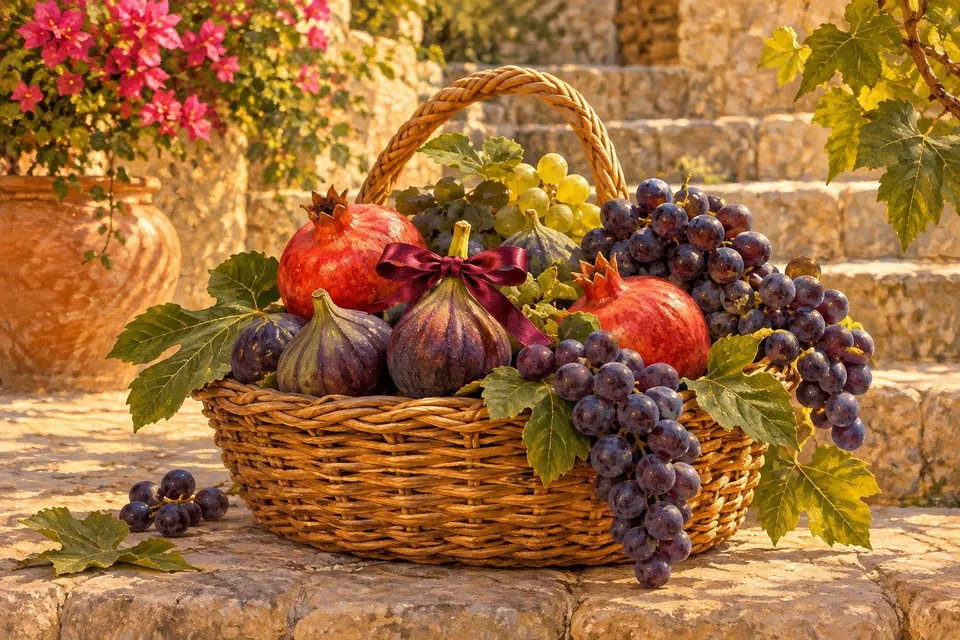
Parashat Ki Tavo begins with the mitzvah of bikurim: bringing the first fruits of the harvest to the Temple and reciting a passage from our portion (Deuteronomy 26:5–10). The landowner brings a basket of the year's first fruits, gives it to the kohen, and recites a passage about all the good God has done for them. It is also about what He has done for all of us: it tells of the great help from Heaven on which the birth and existence of the Jewish people, and our attainment of the Holy Land, depend.
This passage teaches us to express recognition and boundless gratitude. The Torah begins with the words “Bereishit bara Elohim”—“In the beginning, God created” [Genesis 1:1]. The Midrash offers another reading: the world was created for the sake of reshit, a word meaning beginning, foundation, or first. Three things are called reshit: Israel, the Torah, and bikurim. It was for their sake that the world was created.
The Alshich asks how the mitzvah of bringing first fruits to the Temple can stand alongside the people of Israel and the Torah. He explains that the mitzvah expresses hakarat hatov, recognition of the good one has received. This quality is one of the foundations of the Jewish people and is reflected in the Torah.
On the words “Go to the kohen … and say to him” (Deuteronomy 26:3), Rashi cites the Sages' explanation of the purpose of addressing the kohen: to say that you are not ungrateful. Rabbi Yaakov Yosef Reinman asks why an affirmative formulation is not used: “to show that I feel grateful.”
Rabbi Reinman answers that when people fully recognize a kindness done for them, they express their gratitude as strongly as they possibly can. A simple “thank you” is clearly not enough. The five or six sentences recited when bringing bikurim form the basis for expressing gratitude. Given the many blessings God bestows on us every day, the most precise way to describe someone who brings bikurim is that they cannot be called ungrateful. Even after reciting this passage, however, they have not expressed the full measure of gratitude they wanted and ought to express.
An addition from Rabbi Yigal Polishchuk: The main part of the Passover Haggadah is built around explanations of this passage. The Maharal of Prague writes in Gevurot Hashem (chapter 1) that the entire purpose of the Passover Haggadah is to express gratitude to the Creator. It is therefore no surprise that it is built on the Torah passage that establishes the foundations of expressing gratitude.
By Rabbi Yissocher Frand
Keep reading
More →Acharei Mot–Kedoshim: The Advice of a True Doctor
A Torah perspective on medical advice, hope, prayer, and the difficult work of giving and receiving warnings.
ParashaShelach: True Greatness Is Not Arrogance
The spies’ report offers a lesson in self-confidence, dignity, and humility.
ParashaChukat: Transition Periods in Life
Rabbi Yissocher Frand explores why times of change call for special care toward ourselves and our families.
ParashaChukat: Appreciate Your Loved Ones
The Song of the Well offers a lesson about recognizing the people we take for granted.







