Lech Lecha: Abraham’s Lessons for Our Generation
Abraham’s journey offers lessons about change, returning to Torah, and building a lasting Jewish community.
In brief
- Abraham’s journey teaches that growth requires the willingness to leave familiar habits behind.
- Those who bring others closer to Torah must take care not to expose themselves to harmful influences.
- A strong Torah community can help sustain Jewish life across generations.
- Yeshivas and kollels can provide a foundation for communities and for those returning to Torah.
Parashat Lech Lecha#
The Vilna Gaon says that the trials of our forefathers and everything that happened to them recur, in one form or another, in each of our lives. God’s call to Abraham to leave his country, his birthplace, and his father’s house has echoed in the lives of many of us. Many years ago, I left the country where I was born, my familiar surroundings, and my family to settle in a place I had been directed to from Above. Many of us could say something similar about ourselves.
Or HaChaim writes on this passage that, throughout the generations, as long as Jews are in exile, a desire awakens within them to go up to the Holy Land. This is none other than the voice of God when He said to Abraham, lech lecha—“go forth.”
Leaving the Familiar#
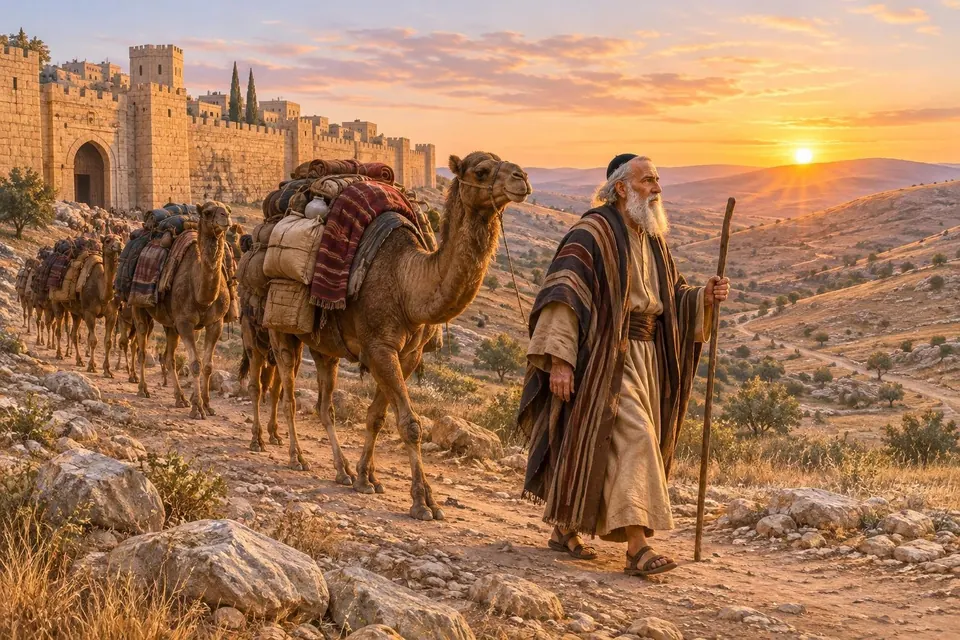
At first, God simply tells Abraham to go, supporting His command with many promises: that Abraham’s name will grow, that God will make him into a great nation, and that Abraham himself will become a blessing [Genesis 12:1–2]. We all know from experience that when someone must leave their birthplace and part with familiar things and surroundings, it can feel as though the ground is slipping out from under their feet. I remember that, the day before I left the Soviet Union, I suddenly realized I was leaving the world I knew, without knowing where I was going or why.
We are told that Abraham’s trial—and the way he endured it—gave him all the great merits described in the weekly portion. We can compare this to someone with a job that is not especially prestigious, a salary that is not particularly high, and a lunch break meal that is nothing special. But because the worker is used to it and life has settled into a rhythm, they do not want to change anything. If someone suddenly suggested leaving it all behind, they would think about it and most likely refuse. They are reasonably comfortable where they are. But if they were promised an immediate rise of several levels, they would be more likely to agree.
One of the hardest challenges for people returning to Torah is the feeling that they will have to leave their familiar lives behind. I remember that when one of my older daughters had to change some of her habits, she objected sincerely: “How can I change? I’m already grown up!” She was about eight years old. How much more was asked of Abraham, whom God required to change completely and leave his familiar surroundings. Yet without that step, he could not have attained what he later did.
To reach a higher level of closeness to the Creator, a person must detach from their previous state. My late mother lived in America for many years. Only when she became ill did we bring her here to Israel, where she lived with us until her death. She began to awaken to teshuvah, and something she told me just days before she left this world shed light on many things for me: “If it weren’t for my illness, I could never have thrown off all the tinsel I was living among.” That is exactly what God wants from us: to throw off the tinsel. Often, it is far from easy.
Staying Young#
Abraham was 75 when he left the place he knew and went to live in the Land of Israel—not exactly a young age. At 86, he married Hagar, and when he was 99, God gave him the mitzvah of brit milah (circumcision), so that he would “be whole” [Genesis 17:1]. These important events in Abraham’s life took place at an advanced age. For most people today, by the time they reach 90, all such events are far back in their youth—if they are privileged to reach that age at all.
I once saw an observation about this: one must know how to stay young. This does not mean avoiding life experience or failing to use it. It means not becoming set in one’s ways. We must always be capable of growing, changing, doing and discovering new things, and moving forward. We should be afraid of living on autopilot.
King Solomon said in Ecclesiastes, “Remember your Creator in the days of your youth” [Ecclesiastes 12:1]. The straightforward meaning is that one should do teshuvah while still young, when the evil inclination is especially strong. If someone overcomes the powerful inclination that draws young people toward forbidden things, their teshuvah is considered complete, because they have overcome the great influence of the yetzer hara (the evil inclination).
If, for example, someone has been immersed in sexual misconduct and does teshuvah at 90, when they no longer have the strength for it, their teshuvah will be very incomplete. If someone ate forbidden foods all their life and later had to give them up for health reasons (and repented of the past violations), that teshuvah is also accepted, but it is not complete.
The Zohar offers another understanding of the passage in Ecclesiastes: when people are young, change comes easily. As they grow older, change becomes harder, and they may be unable to change at all. Knowing how to be young means being able to change even when you are 75, 99, or over 100.
After a brit milah, we say the verse bedamayich chayi—literally, “by your blood, live” [Ezekiel 16:6]. A person returning to Torah must leave behind much of what they are accustomed to and what seems to give them vitality. Such a step can feel like being cut to the quick. And here the Torah tells us: the blood with which you cut away all the evil to which you are attached and which has become part of you—that very blood will be the source of your true life.
The harder it is to distance oneself from evil, the more “blood” is shed in the process, and the more vitality a person will have if they can overcome the evil inclination. Often it seems that giving up old habits, so comfortable and so useful, can cause harm. At that very moment, the Torah tells us, bedamayich chayi: by this blood, with which you push away everything old and unnecessary, you will live.
Among God’s promises to Abraham is that he will be a blessing. Our Sages say that Abraham was given a special power to bless others. God also promises to bless those who bless Abraham and curse those who curse him—a promise that applies to the entire people of Israel [Genesis 12:2–3].
I would like to draw special attention to how much we can gain from a good but difficult habit: always wishing another Jew well. When we meet someone and wish them well, we fulfill the great commandment of the whole Torah, “Love your neighbor as yourself” [Leviticus 19:18]. Each of us likes it when others wish us well, and by wishing others well, we express our love for them.
Through our blessings, we merit God’s blessing. At first glance, the two seem utterly unequal: our little blessing on one side, and God’s blessing on the other. Yet this is what the Torah promises us. And if the habit of blessing is a key to blessing, the habit of taking care never to curse anyone or wish them harm can save our lives and the lives of our loved ones—in the most literal sense.
The Souls Made in Haran#
The Torah says that when Abraham set out, he took his wife Sarah, his nephew Lot, their possessions, and “the souls they had made in Haran” [Genesis 12:5]. A Midrash offers a striking observation: even if all the sorcerers and magicians in the world gathered together, they could not give a soul to a single mosquito, let alone “make souls.” Many Sages explain that these “souls” were converts whom Abraham and Sarah brought to the true faith; that is why they are described as having “made” them.
The great Torah commentator Onkelos was himself a convert. The work he wrote under the inspiration of the Holy Spirit, Targum Onkelos, is read by Jews around the world every day. It renders and explains the Torah in Aramaic. Onkelos writes that all these souls were brought under the authority of the Torah [Targum Onkelos on Genesis 12:5]. We can briefly explain this as follows: living according to God’s will means submitting ourselves to the Torah, and true life is a life lived according to the Torah. That is why Abraham and Sarah are said to have “made” souls.
Another small detail can and should teach us a great deal: the Torah says “they made,” not “he made.” Rashi explains that Abraham worked with the men and Sarah with the women [Rashi on Genesis 12:5]. This is an essential principle of kiruv—bringing Jews closer to Torah—that some people carelessly forget.
Abraham was a great righteous man and far from young; the same can be said of his wife Sarah. Nevertheless, Abraham worked only with men, and Sarah only with women. This is always worth remembering, especially for people serving as emissaries or working as teachers. The proper arrangement commanded by the Torah is that men teach men and women teach women. Some good people have treated this rule carelessly, stumbled, and fallen very low.
There are undoubtedly cases in which a one-time consultation or lesson with someone of the opposite sex is permitted, but it must never become a regular arrangement. Better still, one should consult a knowledgeable rabbi beforehand in each such case about whether it is appropriate and what dangers may be involved.
Many people who undertake kiruv—bringing non-observant Jews closer to Torah and mitzvot—decide that this mitzvah is so great and all-encompassing that it can override all the other commandments. But we have an important principle: a mitzvah whose performance involves violating other commandments is not a mitzvah. We were not commanded to do that.
There is another Midrash I would like to mention in connection with kiruv. It says that Abraham did much to bring converts to Torah. At the same time, he was on such a high level that there was no danger of his being “infected” by anything bad from them. In modern terms, Abraham had complete immunity to the evil that came from idol worshippers. How many of us can boast of such immunity?
Thinking of Rabbi Elazar Menachem Shach and his caution, I would like to mention an idea that arose more than 20 years ago, during a major wave of aliyah—immigration to Israel—from the Soviet Union. Many respected rabbis suggested that every observant family in Israel take one newly arrived family, who knew nothing about Judaism and observed no mitzvot, under its wing to teach them and bring them closer to Torah.
When the idea reached Rabbi Shach, he was firmly opposed. He was not opposed to kiruv itself, but to making such a project obligatory. It is no secret that, in the course of teaching a non-observant family, a religious family may itself be infected by things very far removed from Torah, instead of teaching them a Torah way of life. While not opposing the idea in itself, Rabbi Shach advised every family interested in kiruv to consult a competent rabbi first about whether they should undertake it at all. One of the basic principles of kiruv is knowing how to influence others without being subjected to harmful influence yourself.
At one time, I was offered work with people traveling from Russia to America who were stopping at an intermediate point in a suburb of Rome. When I went to Rabbi Shach to ask him about the offer, he answered me directly: “I don’t advise it. Not because you are already a talmid chacham—a Torah scholar—and the work would take too much time away from your studies, but because it could have a corrupting effect on you.”
An important rule for life is chayecha kodmim: your own life comes first. The Torah gives us many commandments concerning helping others, and we must never be indifferent to our neighbors. But, to use an analogy, you should not jump into a fire if you are in danger of being burned and have no assurance that you can rescue anyone from it.
This is a delicate question for people considering kiruv, especially those who plan to travel abroad and spend time away from their families: how can they ensure that they themselves are not harmed by the work?
We see that Abraham and Sarah “created” many souls in Haran, and the Torah explicitly names some of his disciples, such as Eliezer. This raises a question: where are all those souls, and what remains of them? I have heard and read that, in fact, virtually nothing remains of that enormous number of people who received Torah from Abraham himself. But that does not mean our forefather’s efforts were wasted.
A Midrash says that God, as it were, weighed Abraham: if he successfully withstood all his trials, he would merit an enormous reward—the entire Jewish people would descend from him. If he did not withstand them, he would certainly be rewarded for his righteousness and good deeds, but a people could not be built upon him. It seems that the souls who turned to Torah through Abraham’s work were the reward he merited, even though God’s people could not in fact be built upon them.
Building for Future Generations#
Today, more and more Russian families are turning to the faith of our forefathers. Among them are Jews and non-Jews who become righteous converts. All of this is a great Kiddush Hashem—a sanctification of God’s name. But we must make sure that this wave of inspiration does not become merely a passing episode in our generation. It should instead be the building of an “everlasting edifice,” as we wish every newly married couple.
We need to put down roots in Jewish life so that we do not merely do teshuvah and begin observing the Torah ourselves, but establish a foundation for future generations that cannot be shaken. A distant relative of mine, a scientist about whom I had heard many good things, did teshuvah “on the way from Russia to America.” Many years later, when he came to the Holy Land, we met and talked. From our conversation, I understood that his children had not followed his path. Despite some attempts to involve them in Torah and mitzvot, they had become part of secular American society.
Now I want to speak especially to those doing teshuvah at an age when they are still having children: do everything possible to ensure that your teshuvah and your Torah remain not only in your own family, but are passed on to future generations.
Abraham had disciples of the greatest merit, such as Eliezer. Nevertheless, Eliezer did not merit giving his daughter in marriage to Isaac, nor did he become the founder of a great line of Torah sages.
Someone recently posed an interesting question to me. Today many converts come to the faith, yet their qualities are far from Eliezer’s. Even so, they join our society and become part of it. They have descendants and become full members of our people.
The answer seems to lie in a basic distinction. When there is a strong core, a powerful center, it is relatively easy to join it, draw strength from it, and move forward with it. But when someone is required to found a line of righteous people and provide the driving force for their descendants themselves, entirely different qualities and strengths are needed.
In the days of Abraham and Eliezer, there was no Jewish people as such and no established core. Each person had to become a foundation themselves. Only a few merited this: Abraham, Isaac, and Jacob, but not Abraham’s disciples. Today, thank God, there is a strong core, the righteous part of our people. When someone comes to Torah and becomes Jewish, they join our people and become part of it. The merits of that righteous core give both them and their descendants the strength to remain part of the people for not just one generation, but two, three, and so on until the coming of the Messiah.
At our Beerot Yitzchak Foundation, much is done to bring people closer to Torah: classes for men and women, and daily and weekly Beerot Yitzchak publications distributed around the world. The effect of our work varies greatly. We can imagine, for example, a Jew who was completely distant from Judaism encountering some materials, listening to a class, and beginning to observe Yom Kippur. That is undoubtedly an enormous step and a great merit. The question is whether it provides a foundation for future generations. Most likely, it does not.
Observing Yom Kippur personally is good. Attending a class once a week is priceless. But the main task of a non-observant person in this world is to draw close enough to the Creator to become a foundation for future generations. It is a great pity that people often do not understand this.
I would rather not touch on a subject close to many people and therefore somewhat painful, but the example is instructive: Jewish life in Moscow. Those who live there or even visit occasionally will understand what I mean. On the one hand, thank God, Jewish life in Moscow has progressed enormously compared with what it was when I left Russia. Moscow has many communities, synagogues, and kosher restaurants, as well as kollels, religious preschools, and schools.
But look more closely, and especially ask families living in Moscow whether it is easy to raise children in that environment and whether their children absorb the teachings of Torah from what they see around them. Sadly, the answer will often be no. This is despite the many sacrifices observant Muscovites make to keep mitzvot: difficulties at work over Shabbat and holidays, the need to get to a minyan, and building a sukkah. They make many sacrifices.
Yet despite all this, Moscow lacks the essential thing we are discussing: a fully developed righteous Jewish community that people can return to and join, one that gives strength and protection. Instead, each family must build itself and raise its children on its own, and that is very difficult.
This is what we know about Russia’s largest city, with its highly developed communities. What can we say about cities where only two or three observant families live? Yet such places are the majority, not only in Russia but also in Europe and America. When we return to Torah, we need to look far into the future and envision our children and grandchildren growing up with Torah and living by it, drawing strength from our holy people while rooted deeply in the family—the family that you and I have founded.
The Need for a Community#
Recently was the yahrzeit (anniversary of the death) of Rabbi Ovadia Yosef, a great Torah sage and righteous man. From what I have heard about him, one cannot help noticing the remarkable combination of his Torah genius and his constant, devoted study with his continuous outreach to his community to bring it closer to Torah.
Rabbi Ovadia Yosef’s classes and influence were not wasted. They encouraged people to continue growing and developing: to attend more Torah classes and go on to yeshivas, kollels, and seminaries. The influence of a great Torah sage devoted to studying and spreading Torah, together with the influence of the community’s core, is especially powerful when the great rabbi is the flint that lights a fire in Jewish hearts, while the whole community—its yeshivas, kollels, and classes—is the oil without which the fire quickly goes out.
It is not enough simply to ignite a person’s interest in Judaism; that person must ignite others in turn. And for that, they need to join a healthy Jewish community. A special feature of the Holy Land is that almost everywhere has a yeshiva or a kollel, and often several.
The leader of our people, Rabbi Aharon Leib Shteinman, traveled to North and South America and Europe to support our communities in exile, despite his advanced age and less than robust health. I have read about what he said on those trips. One point was this: if you want large, strong communities, you must have a kollel or a yeshiva—places where Torah is studied deeply and seriously. Without them, there will be no community. If we want to bring Jews back to Torah, we can bring them back only into a large, strong community built on Torah study.
Last week we read the portion of Noach and discussed how Noah’s Ark alludes to the Shechinah (Divine Presence) in exile. We cited Rabbi Yitzchak Hutner’s teaching that, in our generation, Noah’s Ark is the places where Torah is studied.
We live surrounded by a flood of impurity. If someone is literally drowning in mud and is given a glass of water just to wash their face, their face may become cleaner, but they are still in the mud. They must be pulled out and taken from that place into Noah’s Ark. Unless people join the community of Israel, no kiruv will bear the fruit we expect from it.
I owe a great deal in my life to Rabbi Yosef Godenthal. He studied at the Ponevezh Yeshiva and later founded a yeshiva in Ofakim and a religious community in the city.
When the mass aliyah of Jews from Africa and other Eastern countries began, a danger arose that our sages immediately pointed out: the meat grinder of non-religious society, which would grind everyone up until nothing remained. At that time, an organization called Yad LeAchim—literally, “a hand to brothers”—arose to help those who came here and found themselves caught in this terrible machine that severed every connection to religion.
When Rabbi Shach was asked what to do, he replied: go to the new towns, to the settlements for new immigrants from North Africa and Iraq, and establish yeshivas there. Following Rabbi Shach’s advice, Rabbi Godenthal, who lived in Bnei Brak, went to Ofakim, a place he had never been before. Literally knocking on every door, he gathered the first students for his yeshiva.
Today there are thousands of observant families in Ofakim and thousands of graduates of that first yeshiva. It took many years for the yeshiva to become truly established, and I saw the fruits of its work. Even without engaging directly in kiruv, that yeshiva transformed the entire city.
It is not for us to decide for the entire people whether to go or not. God will guide each family to the right decision at the best time for them. But if anyone in Europe or America decides to leave their familiar society and join the holy community of the Land of Israel, their merit is great.
Even if aliyah seems too daunting, one should do everything possible to settle in a place with a healthy Jewish environment. These are not instructions, but simply examples: a Haredi neighborhood in New York for Americans, or Zurich, Antwerp, or Gateshead for Europeans.
Broadly speaking, all we need is a yeshiva or kollel in every place with a Jewish community. Ten righteous people who study Torah and teach those who want to learn can transform our entire people throughout the world.
For a long time, the Lakewood Yeshiva, which was for many years the largest yeshiva not only in America but in the world, had a program that sent a minyan—10 avreichim (married Torah students)—to different countries around the world. I was in Chicago a few years ago, and what did I find there? A Lakewood kollel. All of these are the very “Noah’s Arks” we need to build.
By Rabbi Yigal Polishchuk
Keep reading
More →Acharei Mot–Kedoshim: The Advice of a True Doctor
A Torah perspective on medical advice, hope, prayer, and the difficult work of giving and receiving warnings.
ParashaShelach: True Greatness Is Not Arrogance
The spies’ report offers a lesson in self-confidence, dignity, and humility.
ParashaChukat: Transition Periods in Life
Rabbi Yissocher Frand explores why times of change call for special care toward ourselves and our families.
ParashaChukat: Appreciate Your Loved Ones
The Song of the Well offers a lesson about recognizing the people we take for granted.







