Bo: The Reward for Matzah in Auschwitz
A survivor asks whether he should give his friend the reward for a mitzvah they shared in Auschwitz.
In brief
- Shimon risked his life to make matzah in Auschwitz and gave it to a friend.
- They agreed that the friend would eat it, but Shimon would receive the reward for the mitzvah.
- Years later, the friend appeared to Shimon in a dream and asked for the reward.
- A Rebbe advised Shimon to grant the request wholeheartedly.
Parashat Bo#
“In the first month, on the evening of the fourteenth day of the month, you shall eat matzah” (Exodus 12:18). The first month is the month of Nisan.
The Torah made this an obligation. Maimonides (the Rambam) ruled: “Eating matzah on the night of the 15th of Nisan is a commandment of the Torah, as it says, ‘In the evening you shall eat matzah.’ If a person ate a kezayit—an olive’s volume—they have fulfilled the commandment” (Maimonides, Laws of Chametz and Matzah 6:1).
I heard this story from the great Rabbi Isaac Shlomo Ungar, head of the Machane Efraim yeshiva and chief rabbi of the Chug Chatam Sofer community in Bnei Brak. One day, a member of the community came to him, deeply shaken, and told him an extraordinary story.
It had begun 30 years earlier, in the Auschwitz death camp.
Matzah in Auschwitz#
Hungarian Jews arrived in Auschwitz toward the end of the war. As the Nazis suffered defeat after defeat, the Hungarian government decided to rebel against the Germans, who had made Hungary a vassal of Nazi Germany. But the Germans succeeded in subjugating Hungary completely. They herded the Jews into ghettos and, over a period of several months, sent about a million people to be murdered. May God avenge their blood.
This Jew—let us call him Reb Shimon, for the sake of the story—was among them. He was separated from his wife, and his children were sent to the gas chambers. A blue number was tattooed on his arm, but he was left alive. The work was hellish, and the prisoners lived on a piece of bread and a cup of soup a day.
The man who shared his bunk was a “son of holy people,” a descendant of a distinguished family of great righteous men. He constantly strengthened Shimon’s faith and trust in the Creator, using every free moment to study Torah and repeat the teachings of the righteous. One day, he turned to Shimon in great agitation: Passover was approaching! They had plenty of maror, the bitter herbs—or bitterness—but where could they get a kezayit of matzah?
Thank God, the Almighty can always bring salvation, whether to many or to few. Allied aircraft bombed a food warehouse near the camp. There were sacks of grain there, a real treasure for the prisoners. But anyone who tried to bring this treasure into the camp risked his life.
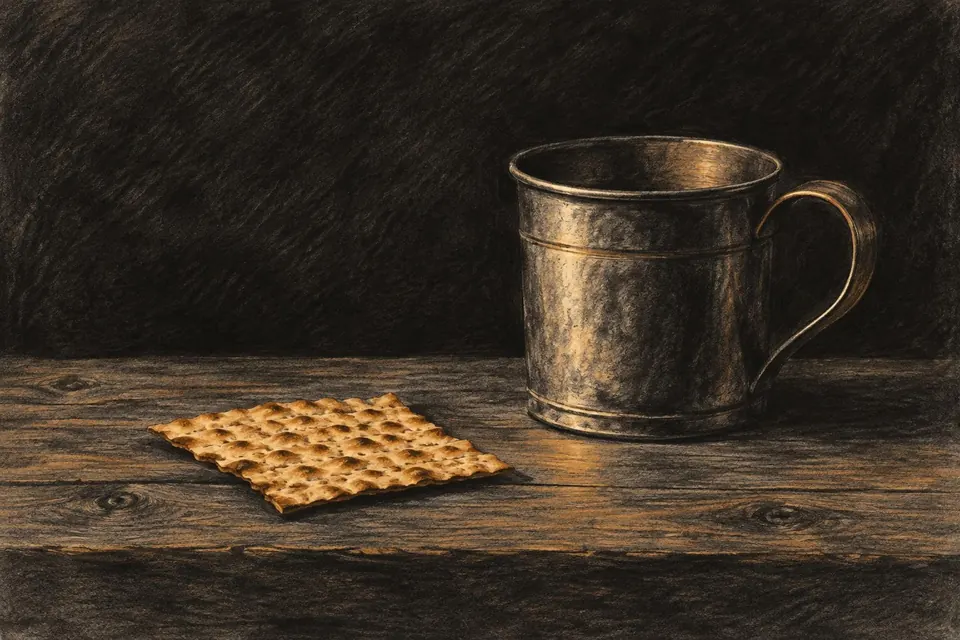
Shimon told his friend about it, and the man began encouraging him, urging him to make the sacrifice. In the end, Shimon managed to hide a couple of handfuls of grain. During the short daily break, he smoothed two stones and used them to grind the grain. Then he found a piece of iron, heated it until it glowed, mixed the flour with water, made a flat cake, pierced it with a nail, and baked it.
The result was a hard, dense cake the size of his palm. Because it was very thick, it contained two portions of a kezayit each: one for him and one for his friend. Now he had to bring it into the camp. If he were caught …
Shimon put the cake inside his shirt and pressed his arm against his body. He made it through the inspection at the camp entrance and headed for his barracks. A German standing at the entrance to the barracks noticed that Shimon was holding his arm against his body in an unnatural way.
“What are you hiding there?” he shouted, roughly pulling Shimon’s arm away. The matzah fell. The German stepped on it with his dirty boot, then brought his club down with all his fury on the unfortunate Jew’s back. Shimon fell into the mud, almost losing consciousness, and the German went off to look for another victim.
With the last of his strength, Shimon gathered the crumbs of matzah for which he had nearly given his life. He dragged himself to his bunk and fainted. His friend brought him around, washed his face, and gave him water to drink. Shimon opened his hand and showed his friend the treasure. A handful of diamonds could not have moved him more. Ah, matzah, holy matzah, here in this “valley of tears,” in this hell—a ray of light in a kingdom of darkness. But alas, all the crumbs together made up only one kezayit, and no more.
An Agreement on the Bunks#
His friend began to plead with him: “Please, give me the matzah! I’ve never had a Seder without matzah in my life!”
“Out of the question,” Shimon replied. “The kezayit is mine! I was nearly killed for it. I can’t give it up!”
His friend kept pleading. “I’m begging you. I’ll recite the whole Haggadah for you—I know it by heart—and even the Song of Songs. You can repeat it after me, word for word. Just give me the kezayit!”
Shimon refused.
“I’ll give you my entire share in the World to Come for this matzah! Listen, I’ve lost my whole family. Everything I had in this world is gone. At least let me have a kezayit of matzah …” the man sobbed.
“But I’m in exactly the same position,” Shimon sobbed in reply.
In the end, Shimon gave in to his pleas, and they reached a compromise: his friend would recite the whole Haggadah and receive the matzah, but the reward for the mitzvah would belong to Shimon. After all, “the reward is according to the effort” [Mishnah Avot 5:23], and how he had risked his life and suffered for it!
That is what they did. That evening, his friend whispered the Haggadah to him, and together they wept over the words, “This year we are slaves; next year, may we be free.” Together they quietly sang Hallel, the psalms of praise, and declared, “Next year in Jerusalem!” His friend ate the matzah.
The next day they went out to work. His friend prayed in a whisper, softly sang Kel Betaatzumot, a prayer in praise of God, and closed his eyes as he recited the Shema. He bowed almost imperceptibly during the Amidah. But when he reached Hallel, he could contain himself no longer. He stood upright and cried out the blessing at the top of his voice. The murderers’ bullet struck him that very moment, and he fell dead. May God avenge his blood.
Shimon survived. After the war, he went to the Land of Israel and began to rebuild his life. He raised a wonderful family and became a member of the Chug Chatam Sofer community in Bnei Brak.
A Friend Appears in a Dream#
Shimon told the rabbi all this as a preface. The most important part had happened that very night: he had dreamed of his friend. The man was dressed in white, and his face shone with a heavenly light.
“Do you remember that you gave me the matzah on condition that you would receive the reward for the mitzvah?” he asked Shimon.
Of course he remembered. How could he forget?
“I’ve come to ask you a favor. Please give me that reward. I received the reward for all the mitzvot I performed, except this one. It’s the only deed for which I haven’t received a reward. Please, be kind and give me the reward for the mitzvah too!”
Shimon was stunned by the request. How could he dare? He reminded his friend: “The matzah was mine. I risked my life gathering the grain, grinding the flour, baking it, and bringing it into the camp. I was beaten for it, nearly to death. You cried and pleaded, and I gave you the matzah. At least let me have the reward for it …”
His friend agreed with everything he said, but reminded him that he was the one who had kept track of the Jewish calendar and told Shimon when Passover began. He had urged him to get matzah, and he had recited the Haggadah. That was why he was asking for the reward for the matzah. He had come down from the upper world and appeared to Shimon for this; it mattered that much to him.
Shimon refused. The face of his holy friend clouded with deep disappointment, and he disappeared.
Shimon woke in a cold sweat, completely shaken by the dream. He did not know whether he had acted properly. On the one hand, the Torah says, “Your life takes precedence” [Bava Metzia 62a]. His friend had no justification; the request was simply brazen. On the other hand, how could he turn away a holy soul and refuse the request of someone who had died?
“And so he came to me,” Rabbi Ungar told me. “He asked whether he had acted properly, or whether perhaps he should have given in. I told him this was not a question for an ordinary rabbi, but for a Rebbe, and I sent him to the Machnovka Rebbe. I asked him to come back afterward and tell me what the Rebbe had decided.”
“And what did he say?” I asked, curious.
“He came back the next day and …”
Shimon had waited impatiently for evening, when the Rebbe received visitors. He went in and told him his story.
The Rebbe listened and said, “In fairness, you should give it to him …”
“What do you mean, in fairness?” Shimon protested. Surely fairness did not require him to give it up. The only question was whether he should act generously and do more than he was obliged to do.
The Rebbe explained: “Understand, your friend has died. What he has is what he has. The mitzvot he performed are credited to him, but he cannot earn any more. There is one mitzvah he performed for which he did not receive a reward, and he feels its absence.
“But you are alive! You put on tefillin, wear a tallit (prayer shawl), pray three times a day, and say 100 blessings a day. And what about Shabbat and the festivals? There are countless mitzvot! You have children, and you are raising them to perform mitzvot. Every mitzvah they perform is also credited to you, because of the upbringing you gave them. Isn’t it fair for you to give your friend the reward for one mitzvah?”
“Well, Rebbe, if you say so, I’ll give it to him …”
“No, my dear, not like that. You must give it up wholeheartedly,” the Rebbe said firmly. He took a bunch of keys from his pocket.
“Go to the nearest beit midrash (study hall). There is no one there now. Open the door with this key. Turn on the light and open the aron hakodesh (the Torah ark) with this key. Stand right up close to it; put your head right inside. And pour out your heart before God.
“Tell Him everything: how you met, what close friends you were, how he constantly supported and encouraged you, how he spurred you on to find the grain and bake the matzah. Tell Him about that Passover Seder on the bunks, in the pitch darkness. Relive that night, the last night of your friend’s life. Then say that you are giving him the reward for the mitzvah with all your heart, to bring joy to his soul in the upper world. After that, come back to me.”
Shimon did as he was told. Memories flooded over him; sights and sounds surrounded him. He truly felt as though he had lived it all again, and it drained him of all his strength.
He closed the ark, kissed its curtain, turned off the light, and locked the synagogue. He returned the keys to the gabbai (synagogue attendant), but no longer had the strength to go to the Rebbe. He asked the attendant to tell the Rebbe that he would come the next day. Completely exhausted, he dragged himself home and literally fell into bed.
His friend appeared in a dream. His face glowed and shone: he had come to thank Shimon for granting his request.
The Value of a Mitzvah#
In the morning, Shimon went to pray with the Rebbe’s minyan, or prayer gathering. After the service, he told the Rebbe that his friend had appeared to him in a dream a second time. The Rebbe was not surprised, but said to Shimon:
“Look, Reb Shimon. Your friend was the son of holy, righteous people and grew up in a home full of Torah and reverence for God. Without a doubt, he himself performed many mitzvot and good deeds. He had the merit of dying while sanctifying God’s Name, and if there were any claims against him in Heaven, that death atoned for every one of them.
“So many mitzvot, and no sins. And more than that: the Sages testify that those who died sanctifying the Creator’s Name are in such an exalted place, in the upper Gan Eden (Garden of Eden), that no one can stand beside them. Yet he left the greatest delight in the radiance of the Shechinah (Divine Presence) and came down to this world to beg and plead, quite literally like a pauper, for the privilege of receiving the reward for one single mitzvah.
“And what about us? How many mitzvot lie at our feet, while we do not even bend down to pick them up!
“Every chapter of Torah studied, every mishnah, every page of Talmud. How many mitzvot there are in every Torah lesson! And how carelessly we spend our hours!
“Any help we give another person, any encouragement or kind word—what a mitzvah it is! Yet how indifferent we are, how often we ignore these opportunities.
“Your story is a true lesson in mussar—ethical teaching!”
“And all this,” Rabbi Ungar concluded, “he came back and told me …”
By Rabbi Yaakov Galinsky
Keep reading
More →Passover Wine: What to Drink at the Seder
The four cups are a central part of the Seder, and grape juice can be used when wine is difficult to drink.
Guide · PassoverWhat Goes on a Seder Plate?
- 1. Zeroa
- 2. Beitzah
- 3. Maror
How Did the Klausenburger Rebbe Find Matzah in a Nazi Camp?
PassoverWhy Tell Children About the Exodus at the Seder?
The stories of the Exodus teach children that God cares deeply about them.







