What Goes on a Seder Plate?
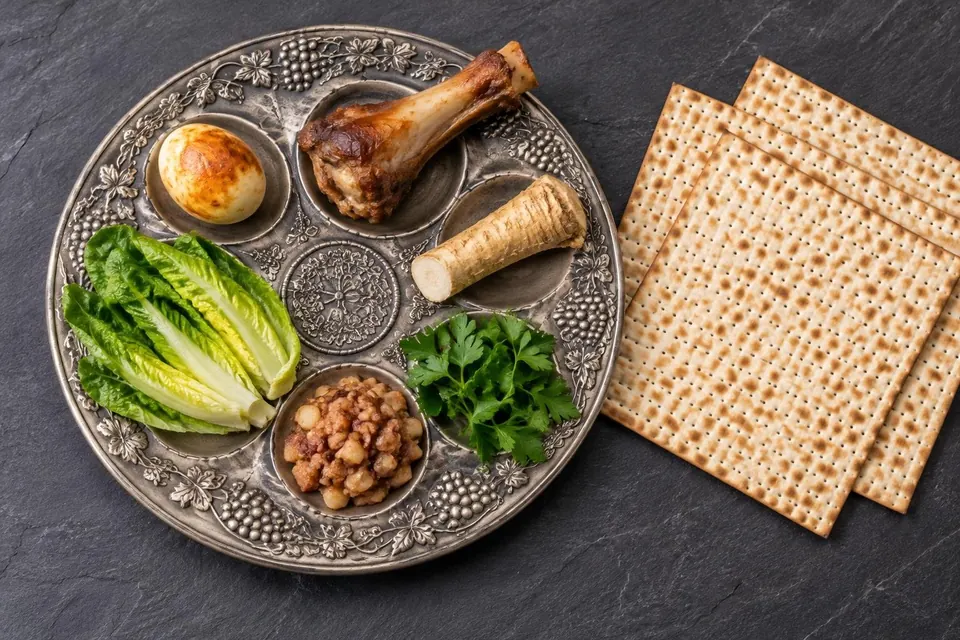
The Seder plate holds six items that recall the Exodus, the Temple offerings, and the bitterness of slavery.
In brief
- A Seder plate generally holds six items, including reminders of the Temple offerings and the bitterness of slavery.
- The maror is dipped in charoset, and the karpas is dipped in salt water.
- Three matzot are usually placed beside or beneath the plate.
- The Arizal, the Rema, and the Vilna Gaon each had a different way of arranging the Seder items.
At the festive table, a special plate called a kearah in Hebrew is placed near the Seder leader. It holds the main items needed for the Seder.
There are generally six Seder items:
1. Zeroa#
Zeroa (shank bone) is a roasted or baked piece of meat with a bone. It recalls the Passover offering eaten at the Passover meal in Temple times (Pesachim 114b).
The zeroa is roasted over coals or an open flame (Shulchan Aruch, Orach Chaim 473:4; Mishnah Berurah 473:28–29). One should not say that the meat is lePesach (“for Passover”), so that it does not sound as though it is being consecrated as a Passover offering (Shulchan Aruch, Orach Chaim 469; Mishnah Berurah 469:2).
Today, a chicken wing is usually used for the zeroa.
The zeroa is not eaten during the Seder. In general, it is customary not to eat meat roasted over an open flame or coals on the night of Passover, so that no one will think it is meat from the Passover offering (Pesachim 53a; Shulchan Aruch, Orach Chaim 476:1–2; Mishnah Berurah 476:1). It may be eaten the next morning (Mishnah Berurah 473:32).
2. Beitzah#
Beitzah (egg) is an egg that has been hard-boiled or roasted over a flame. It recalls the festival offering known as the chagigah (Shulchan Aruch, Orach Chaim 473:4, Rema).
This offering was brought in the Temple on days with the status of Yom Tov (a festival). On Passover, its meat was eaten at the Passover meal before the meat of the Passover offering. In Talmudic times, a piece of meat was prepared for the Passover table as a reminder of the chagigah (Pesachim 114b).
Today, an egg is used for this purpose, in part because it is a sign of mourning. Even at a time of celebration, we mourn the destruction of the Temple and our inability to bring the prescribed offerings there. It is good to eat this egg during the Passover meal (Mishnah Berurah 473:23, 473:32, 476:9, and 476:11).
3. Maror#
Maror is bitter greens that recall the bitterness of slavery in Egypt. As the Torah says: “The Egyptians forced the children of Israel into harsh labor, and they made their lives bitter (vayemareru)” (Exodus 1:13–14).
Lettuce, called chasa in Israel, is usually used for maror. Prepare at least two portions of maror for each Seder participant, each the size of a kezayit (an olive’s volume). In modern measures, a kezayit is equivalent, according to different estimates, to 30–50 grams (about 1–1.8 ounces).
The lettuce must be checked carefully for insects. Many people use the firm stalks and roots of the lettuce rather than the leaves for the Seder, because insects are rarely found in them. Someone who is not skilled at checking greens for insects is best advised to use grated horseradish as the bitter greens (see Mishnah Berurah 473:41–42).
In Israel, chasa that has been protected from insects during cultivation should be used. Even this lettuce must be checked beforehand, as directed on its packaging (editor’s note).
4. Charoset#
Charoset is a spiced mixture of crushed fruit and nuts, such as grated apples and ground nuts, mixed with red wine. Its reddish-brown color resembles clay and recalls the bricks the Jews made from clay in slavery, as it is written: “They made their lives bitter with hard labor in clay and bricks” (Exodus 1:14; Rema on Shulchan Aruch, Orach Chaim 473:5; Mishnah Berurah 473:48). The name charoset itself comes from charsit (“clay for bricks”).
During the Seder, maror is dipped in charoset.
One possible charoset recipe is two grated apples, half a cup of ground nuts, one teaspoon of cinnamon, and two to three tablespoons of sweet wine.
5. Karpas#
Karpas is a vegetable over which the blessing bore pri haadamah (“who creates the fruit of the ground”) is recited (Shulchan Aruch, Orach Chaim 473:4; Mishnah Berurah 473:20). Celery, parsley, radish (Chayei Adam 130:5; Kitzur Shulchan Aruch 118:2), or a piece of boiled potato may be used.
6. Chazeret#
Chazeret is bitter greens eaten together with matzah. Lettuce, or grated horseradish, is usually used. Horseradish should be grated shortly before the night of the Seder so that it does not lose its sharpness (Mishnah Berurah 473:36).
What Is Chazeret?#
The Mishnah mentions chazeret as one of the types of maror referred to in the Torah: “They shall eat the meat that night, roasted over the fire; they shall eat it with matzah and bitter herbs” (Exodus 12:8). The Hebrew word for bitter herbs is merorim. The Mishnah lists five types of bitter greens, including chazeret and tamcha (Mishnah Pesachim 2:6).
The Talmud explains that chazeret is chasa, the plant known as lettuce; see Rashi. This is the preferred plant for fulfilling the mitzvah of maror (Pesachim 39a). Although lettuce usually does not taste bitter at all, this does not matter: it also recalls that the Almighty showed mercy (chas) to the people of Israel by freeing them from slavery (Chayei Adam 130:3).
Many authoritative halachic scholars identify tamcha as horseradish (Chayei Adam 130:3; Mishnah Berurah 473:36). Nevertheless, in modern Hebrew, the word chazeret commonly means horseradish.
The Arizal’s Custom#
In most communities, including those of the Lithuanian tradition, the Seder items are arranged on the kearah according to the custom of the great Torah scholar and Kabbalist Rabbi Isaac Luria, the Arizal. The six items form two triangles, with their points facing the Seder leader. The upper triangle consists of the beitzah and zeroa, from left to right, with the maror below them. The lower triangle consists of the karpas, charoset, and chazeret (Chayei Adam 130:19/1/; Kitzur Shulchan Aruch 118:8).
Three matzot are placed either beside the kearah or directly beneath it, if the plate is light enough not to break the thin matzot (Chag HaPesach 15:25 /40/). Some people use a raised kearah with three special shelves for the matzot beneath the plate itself.
A separate dish of salt water is placed beside the kearah for dipping the karpas (Chayei Adam 130:19/1/).
The Ten Sefirot#
Those versed in Jewish mystical wisdom explain that the main Seder items correspond to the ten sefirot (Divine emanations) through which the world was created and is governed.
The top matzah corresponds to the highest sefirah, Chochmah (Wisdom); the middle matzah to Binah (Understanding); and the bottom matzah to Daat (Knowledge).
The zeroa, on the right of the kearah, corresponds to Chesed (Kindness), a sefirah of the right column.
The beitzah, on the left, corresponds to Gevurah (Might), a sefirah of the left column.
The maror, in the center, corresponds to Tiferet (Splendor), a sefirah of the central column.
The charoset, on the right, corresponds to Netzach (Eternity), a sefirah of the right column.
The karpas, on the left, corresponds to Hod (Majesty), a sefirah of the left column.
The chazeret, in the center, corresponds to Yesod (Foundation), a sefirah of the central column.
Finally, the kearah itself, which holds and unites all the other Seder items, corresponds to Malchut (Kingship), the lowest of the ten sefirot, which receives the influence of all the others (Talalei Orot, Haggadah Shel Pesach, p. 16; Chag HaPesach 15:25 /40/; Yedid Nefesh 3, p. 57).
The Rema’s Custom#
Rabbi Moshe Isserles, the Rema, gives another way to arrange the Seder items on the kearah in his additions to the Shulchan Aruch. In his view, the items should be arranged in the order in which the mitzvot are performed: what is taken first is placed closer to the leader. This follows the general halachic principle that one does not pass over mitzvot: the item needed for the earlier mitzvah should be closer at hand.
First, the karpas is taken and dipped in salt water, so the karpas and the dish of salt water are placed closest to the leader. Next, the matzah is eaten, so it is placed closer to the center of the kearah. After that, the maror is eaten, followed by the charoset. The maror is therefore placed to the right behind the three matzot, and the charoset to the left. In Hebrew, not only is text read from right to left, but the sequence of time is also indicated from right to left.
Finally, the zeroa and beitzah are placed farthest from the leader, since they are on the kearah only as reminders of the Temple offerings (Rema on Shulchan Aruch, Orach Chaim 473:4). According to this custom, chazeret is not placed on the plate at all.
Some Ashkenazi communities follow the Rema’s custom.
The Vilna Gaon’s Custom#
The Vilna Gaon’s custom is based on a Mishnah from which one can conclude that only matzah, chazeret (lettuce), charoset, and two dishes recalling the Passover offering and the chagigah are placed before the Seder leader (Mishnah Pesachim 10:3; Pesachim 114a).
Accordingly, in the Gaon’s custom, the maror is placed on the right of the kearah, the charoset on the left, and two rather than three matzot in the middle. Farther from the leader are the zeroa on the right and the egg on the left.
This custom, also called minhag Lita (the Lithuanian custom), is followed mainly by adherents of the Vilna Gaon.
Practical law. This page reports a ruling given for a specific question. For your own situation, ask a rabbi who knows you.
Keep reading
More →Passover Wine: What to Drink at the Seder
The four cups are a central part of the Seder, and grape juice can be used when wine is difficult to drink.
How Did the Klausenburger Rebbe Find Matzah in a Nazi Camp?
Bo: The Reward for Matzah in Auschwitz
PassoverWhy Tell Children About the Exodus at the Seder?
The stories of the Exodus teach children that God cares deeply about them.







