Why Remember the Bitterness of Slavery on Passover?
Parashat Bo offers a way to understand why bitter herbs have a place at the Passover meal.
In brief
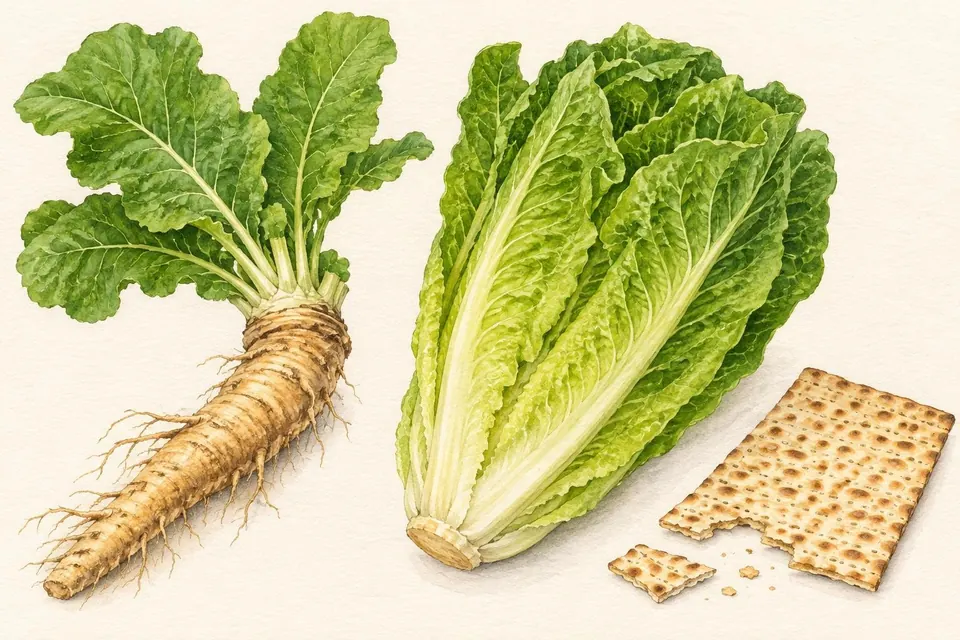
- The Passover offering is eaten with matzah and maror, or bitter herbs.
- The bitterness of slavery is remembered because it led to the Redemption.
- Rabbi Eliyahu Dessler taught that people are created to help others and increase the glory of Heaven.
- Moses and David expressed gratitude for suffering that led to salvation.
Parashat Bo#
“They shall eat it with matzah and maror” [Exodus 12:8]—the Passover offering is to be eaten with matzah and maror (bitter herbs). We need to understand why. Passover is easy enough to explain: God passed over (pasach) our ancestors’ homes when He punished Egypt. And we eat matzah because the dough did not have time to rise. For these things, we give thanks and praise.
But why remember the bitterness? Why recall the hardship of slavery? What is there to be grateful for?
How much we have to be grateful for, and how much we should rejoice in it! Only because of that suffering was the Redemption possible. It was through that suffering that God’s name was sanctified in the world, through the plagues in Egypt and our departure from Egypt. Wasn’t it worth it?
The Talmud says: “The wicked Turnus Rufus asked Rabbi Akiva, ‘If your God loves the poor so much, why does He not provide for them?’ Rabbi Akiva answered him, ‘So that through them (that is, by helping them) we may be saved from Gehinnom’” [Bava Batra 10a].
At first glance, a poor person might protest: Am I a sacrifice for the wealthy? Am I meant to live in poverty and deprivation, which are harder than Job’s suffering, so that the wealthy can escape the punishment of Gehinnom through me?
I heard from the great Rabbi Eliyahu Dessler that someone who asks this question does not understand what is said in Nefesh HaChaim: A person was created not for themselves, but solely to help others in every way they can and to increase the glory of Heaven. Everything in the world is worth it for that!
Similarly, there is a mitzvah to help another person load a burden onto a donkey, and to help unload it. The mitzvah to help unload a donkey that has collapsed under its burden takes precedence over the mitzvah to help load one, because the Torah forbids causing animals to suffer. The donkey is lying under its load, and its suffering is plain to see.
Yet it says: “If it is a choice between helping a friend unload a donkey and helping someone you hate load one, the mitzvah is to help the enemy, in order to overcome your yetzer hara (evil inclination)” [Bava Metzia 32b].
The donkey might object: What did I do wrong? This person wants to overcome his evil inclination and help his enemy, while I’m collapsing under my load! Why should he work on himself at my expense?
But that is a donkey’s logic. If he were not a donkey, he would be glad to become the means by which another person overcomes his evil inclination, even at the cost of his own suffering!
The author of Beit Halevi explains the words of the Midrash this way: Moses said, “I sinned with the word az (‘then’ or ‘since then’), when I said, ‘Since I spoke in Your name to Pharaoh, things have grown worse for this people’ [Exodus 5:23]. And with az I will sing a song to You: ‘Then Moses will sing’” [Exodus 15:1]. Moses was giving thanks after the fact for all the suffering and hardships of slavery, through which we became an instrument for sanctifying God’s name when the Redemption came.
This was also what King David meant when he said, “I will thank You, for You afflicted me and became my salvation” (Psalms 118:21). I will give thanks for the suffering too, for through it came salvation from Heaven, and in this way the Creator’s name was sanctified!
By Rabbi Yaakov Galinsky
Keep reading
More →Passover Wine: What to Drink at the Seder
The four cups are a central part of the Seder, and grape juice can be used when wine is difficult to drink.
Guide · PassoverWhat Goes on a Seder Plate?
- 1. Zeroa
- 2. Beitzah
- 3. Maror
How Did the Klausenburger Rebbe Find Matzah in a Nazi Camp?