A Brief Guide to Passover Seder Laws
A practical guide to the amounts and timing for the Seder’s mitzvot.
In brief
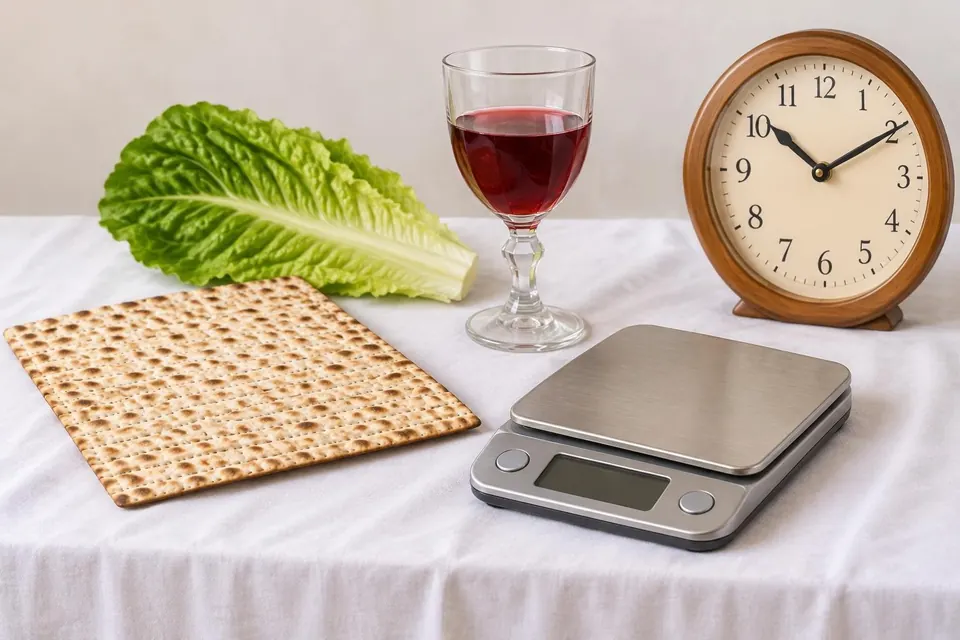
- The Seder’s mitzvot involving food and drink require specified amounts and timing.
- Men recline to the left for these mitzvot, except when eating maror.
- Begin the Seder promptly and involve children in the story of the Exodus.
- Eat the afikoman before halachic midnight.
On this remarkable night, the Jewish people are born anew each year. This is not only a spiritual birth, but also an actual liberation from slavery. On Passover night, our bodies take part in the Seder through several mitzvot: matzah, maror (bitter herbs), four cups of wine, and the festive meal. These mitzvot are fulfilled when they are performed correctly, within the required time and in the specified amounts. They should not be performed with long interruptions.
The Four Cups#
For the four cups, use kosher red wine or 100% natural grape juice. To fulfill the mitzvah, one should drink 150 ml (about 5.1 fl oz) from each cup. According to some opinions, 86 ml (about 2.9 fl oz) is enough.
Ideally, one should drink the entire cup, so it is best to use small cups. If drinking the required amount is difficult, one may drink most of 86 ml. One may drink water after the wine, provided the water was placed on the table beforehand. Ideally, try to drink the entire amount in two gulps. If that is difficult, drink it within four minutes. As a last resort, take five to six minutes.
For all the Seder mitzvot involving eating and drinking the cups, except eating maror, men recline to the left.
Matzah and Its Amounts#
It is very important to have shmurah matzah at the Passover Seder: matzah whose production has been supervised from the time of harvest or milling. It is preferable to eat this matzah throughout Passover.
Ask a rabbi in advance how much of the matzah you have is needed to fulfill the mitzvah. The size of a kezayit (an olive’s volume) depends on the matzah’s thickness and density. A kezayit of matzah weighing 30 grams (about 1.1 oz) is called a “large” kezayit. About 20 grams (about 0.7 oz) is a “small” kezayit.
During the Seder, two kezayit of matzah should be eaten after the blessings Hamotzi and Achilat Matzah. Ideally, this double amount should be eaten by the person leading the Seder and reciting the blessings on everyone’s behalf; two small kezayit are enough for that person. For the other participants, eating two kezayit is more of a stringency.
One should also eat a kezayit of matzah for korech (the matzah and maror sandwich) and a kezayit for the afikoman (the matzah eaten at the end of the meal). Ideally, if possible, eat two kezayit for the afikoman, in remembrance of the Passover offering and the matzah eaten with it. If this is difficult, consult a rabbi about what to do.
To eat the matzah, sit comfortably—men reclining to the left, and women in a position as comfortable as possible for eating—then chew it thoroughly and swallow. Remember that the halachic time for eating the matzah begins with the first swallow. An elderly person may drink a small amount of water with the matzah.
For each mitzvah involving matzah, the order of preference for timing is: try to swallow at least one kezayit at once; try to eat the required amount within two minutes; eat it within four minutes; or eat without interruption, even at one’s usual pace.
Telling the Story#
It is important to begin the Passover Seder promptly, immediately after the evening prayer, so that children do not fall asleep before the mitzvah of eating matzah. At a minimum, children should hear the passage beginning “We were slaves…” [Passover Haggadah, Maggid].
Telling the story in the Passover Haggadah is a Torah mitzvah. Its purpose is to tell your children—first and foremost, as the verse says, “Tell your son” [Exodus 13:8]—as well as the other people present, about the Exodus from Egypt. If someone is holding a Seder alone, they tell the story to themselves.
The Sages therefore teach us to make a number of changes that distinguish the Passover Seder from another festive meal. These changes awaken children’s interest and encourage them to ask what is different about this night. For example, it is customary to give children nuts at the beginning of the Seder, so they will be surprised and begin asking questions. Chocolate and similar treats can be given as prizes for active participation and answers, which can also help children stay awake.
The Afikoman#
The afikoman must be eaten before halachic midnight. This year, in Jerusalem, that is 12:40 a.m. After eating the afikoman, one may continue telling stories about the Exodus from Egypt before the blessing after the meal.
After completing the Passover Seder, one may drink water, tea—with sugar, according to some opinions—and coffee, according to some opinions. But one may not eat anything, so that the taste of matzah remains in the mouth until morning.
Practical law. This page reports a ruling given for a specific question. For your own situation, ask a rabbi who knows you.
Keep reading
More →Passover Wine: What to Drink at the Seder
The four cups are a central part of the Seder, and grape juice can be used when wine is difficult to drink.
Guide · PassoverWhat Goes on a Seder Plate?
- 1. Zeroa
- 2. Beitzah
- 3. Maror
How Did the Klausenburger Rebbe Find Matzah in a Nazi Camp?