How Did the Klausenburger Rebbe Find Matzah in a Nazi Camp?
A Passover story of faith, courage, and a secret Seder in a Nazi concentration camp.
In brief
- Before Passover in 1945, the Klausenburger Rebbe expressed confidence that the prisoners would have matzah.
- After an Allied bombing, Jewish prisoners found wheat and secretly baked it into matzah.
- The Rebbe led a Seder in the camp, reciting the Haggadah from memory.
- Survivors recalled his efforts to avoid forbidden food and encourage his fellow prisoners.
We share with you an extraordinary and unique Passover story: a true triumph of the Jewish spirit over a cruel and merciless enemy who dreamed of destroying our entire people. It tells how a great Torah scholar and righteous man, Rabbi Yekusiel Yehudah Halberstam, the Rebbe of Sanz-Klausenburg, observed Passover in a German concentration camp.
A Brief Biography#
Rabbi Yekusiel Yehudah Halberstam was born in Rudnik, Galicia, in 5664. He was a great-grandson of the Hasidic leader Rabbi Chaim Halberstam, known as the Divrei Chaim, who founded the Sanz Hasidic dynasty. In 5681, he married the daughter of Rabbi Chaim Tzvi Teitelbaum, author of Atzei Chaim, who led the Jewish community of Sighet, Hungary.
Even as a young man, Rabbi Yekusiel Yehudah distinguished himself as a great Torah scholar. At 14, he received rabbinic ordination from Rabbi Meir Yechiel Halstock, the leading Torah scholar of Ostrovtza, and subsequently led the community of Rudnik.
In 5686, he was appointed head of the beit din (rabbinical court) in Klausenburg, now in Romania.
During the Holocaust, the rabbi lost his wife and 11 children. Yet even in the Nazi death camp Auschwitz, his powerful faith strengthened the spirits of his fellow Jewish prisoners.
Immediately after the Holocaust, the Rebbe set about rebuilding Jewish life from the ruins. He breathed the spirit of Torah into Jewish survivors.
In displaced persons and refugee camps, Rabbi Halberstam founded a network of yeshivas and Torah institutions. They provided practical help to survivors and strengthened the spirits of people who had often lost all their loved ones in the fires of the Holocaust.
In 5707, the Rebbe came to the United States, where he began rebuilding the Sanz Hasidic community. In 5716, he visited the Land of Israel and established Kiryat Sanz, a religious neighborhood in Netanya, where he himself settled three years later. Some time later, with the Klausenburger Rebbe directly involved, construction began on a similar neighborhood in Jerusalem and on the Laniado Medical Center in Netanya. Near the end of his life, he undertook a major project: he created the Mifal HaShas program, through which thousands of married Torah students study the entire Talmud.
The great teacher and righteous man Rabbi Yekusiel Yehudah Halberstam was called to the heavenly yeshiva on the night of Shabbat, 9 Tammuz 5754.
Introduction by Rabbi Shlomo Lorincz#
Anyone who wants to understand the great strength hidden in the human soul should read these lines about the remarkable events in the life of a man of great holiness, the Rebbe of Sanz-Klausenburg.
He passed through seven circles of the hell on earth created by the Nazi tyrant, may his name be cursed forever, from the labor camps in Hungary and the Warsaw Ghetto to the Auschwitz death camp. He lost his wife and 11 children, who died sanctifying God's name. Yet despite everything, his spirit was not broken. Even in those terrible places, in the shadow of death, he continued to live a life of Torah and kindness.
As soon as he heard from American soldiers that he was free, he returned to an active life. He continued to follow the ways of his holy ancestors in Torah and service of God, and he encouraged others to do the same. Calling out, “Whoever is for God, come to me” [Exodus 32:26], he filled the hearts of the despairing with life again.
Our teacher brought back to faith those who had grown distant and those whose hearts were troubled by doubt after long years of suffering and horror.
Though he himself had been left with nothing, he helped heal many thousands of Jews, in body and spirit. He cared for hundreds of orphans and helped hundreds of young women marry. Even there, in the German camps, the Rebbe founded a network of Talmud Torah schools, yeshivas for adolescents and young people, kollels (study institutions for adults), and Beit Yaakov schools. He attended to every need of the Jewish remnant that had survived the Holocaust.
After immigrating to the Holy Land, he founded neighborhoods in Netanya and later in Jerusalem with everything needed for daily life: educational institutions, homes for older people and those needing special care, facilities for children, and more.
In Netanya, he also founded a very special institution, Laniado Hospital. He took care to establish major enterprises, which naturally demanded especially great effort from him.
Having endured the Holocaust and all its horrors, he might well have been broken in body and spirit. But he rose above all his personal grief and began rebuilding what had been destroyed, working on his own.
If the Rebbe's great deeds, which we saw with our own eyes, had not been described and documented in detail, future generations would not believe that a Holocaust survivor could put aside all the misfortunes and suffering that befell him in the valley of sorrow and devote himself entirely to serving God for the sake of the whole Jewish people.
This holy man revealed the secret of how he overcame his suffering—the true torment of Job—and especially the loss of his family. He said: “I lost my entire family, I lost everything … But I did not lose the Almighty, blessed be He.”
Food for a Mitzvah, Through Faith#
As Passover of 5705 (1945) approached, the Rebbe prepared to celebrate “the time of our freedom” in the camp, uplifted and inspired by the Haggadah's words: “Great awe—this is the revelation of the Divine Presence” [Passover Haggadah, Maggid]. He seemed not to feel the chains of captivity and slavery imposed on him by the cursed Nazis. No one in the world was as free as he was.
Trusting in the Creator's goodness, he was not frightened by the question of how he would sustain himself through the seven days of the festival, when not a crumb of leavened food would pass his lips. He had no intention of compromising on the prohibition against deriving any benefit from leaven, either—whatever might happen.
The Rebbe and his fellow sufferers made great efforts throughout the winter to gather a few potatoes for Passover. They obtained the potatoes by “stealing” them and hid them in various places: holes and cracks in the barracks and between the bunks. But one day, the cursed Nazis searched the barracks, discovered these treasures, and took everything away. The rabbi, however, did not worry. He entrusted his care to God. “We have done our part,” he said, “and now let God do as He wishes.”
Then, on the day before Passover, just before the festival, those close to him were astonished to see how right the righteous Rebbe had been. For no apparent reason or understandable cause, the camp authorities suddenly ordered a group of Jews to take hoes and shovels into the nearby fields. They were to help local non-Jews open their storage pits, where potatoes had been covered with earth for the winter. The Jewish prisoners managed to smuggle many of these potatoes back into the camp.
A Heart Steadfast in Trust#
It is hard to believe how strong the Rebbe's faith was. Shortly before Passover, he announced with complete conviction that Heaven would surely help him say the blessing on the night of the holy festival: “… and commanded us to eat matzah,” and to eat at least a kezayit (an olive's volume, the minimum required amount) of matzah.
One prisoner, feeling despondent, asked him sadly, “Where will we get a kezayit of matzah for the Seder night?” The Rebbe reassured him without hesitation: “Put your mind at ease. We'll have matzah.”
Two or three days before Passover, as the time drew near, the man came back and asked again, “How will we fulfill the mitzvah of eating matzah?” Once again, the Rebbe answered confidently, “We'll have matzah.”
Rabbi Moshe Eliezer Einhorn, who was nearby, grew angry when he heard the answer. “Where are we going to get matzah?” he asked bitterly. “Will the windows of heaven open for us?” The Rebbe answered him with the same gentle confidence: “You'll see—we'll have matzah.”
An Open Miracle#
An open miracle occurred. That very day, Allied planes suddenly appeared, bombing German strategic targets. Among other things, they almost completely destroyed the railroad station near the camp. After the bombing, the Nazis sent a work detail from the camp to clear the rubble and railway tracks. Twelve Jews were among the prisoners.
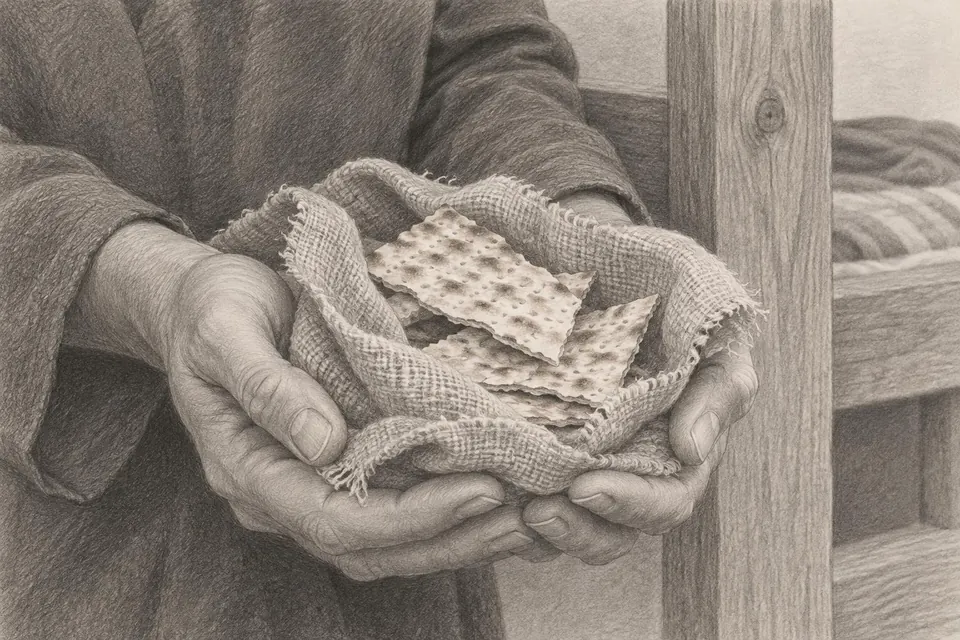
To their surprise, the Jews saw piles of spilled wheat among the wrecked railroad cars. They quickly filled their pockets, despite the fear of being caught and brutally punished. Risking their lives, they smuggled their precious find into the camp.
The Vishova Rebbe, Rabbi Chaim Yehuda Meir Hager, author of Zecher Chaim, was among that group. He recalled:
“It's impossible to describe the joy that came over all of us when we saw that wheat … There was little time … We did it all in secret … We ground it with ‘hand mills,’ quite literally. We crushed each grain into flour with our own hands, using little stones. And when it came time to bake the matzah at night, we all understood clearly how much we were risking our lives. We had to light a fire in the ‘oven’ we had prepared for that purpose in the barracks. There were American bombing raids in those days, and the Germans would have taken any spark escaping outside as a signal to enemy planes. The punishment would have been certain and brutal.”
Matzah Guarded From an Evil Eye#
This was properly guarded shmurah matzah. Clearly, it had not been guarded against leavening from the time of harvest, but from the eye of a wicked enemy. It was late at night, when all the camp's inhabitants were fast asleep, exhausted from the day's labor. Only one small group of people was awake.
They covered the barracks windows with a thick blanket, lit a fire in a small iron pot, mixed the flour with water, and began kneading and shaping the dough with the help of a round wooden board brought from the kitchen beforehand. Their lips whispered Hallel (psalms of praise) with great fervor: “Praise God; praise Him, servants of God” [Psalms 113:1]. Their hearts beat hard: “We are servants of God, not servants of people.”
Outside, concealed near the entrance to the barracks, one Jew stood watch so that, if danger came, they could hide the traces of what they were doing. By Heaven's mercy, all went well. They baked a little kosher matzah, enabling Jews to say the longed-for blessing on Seder night and eat a kezayit of the “bread of affliction.”
Among the matzah bakers was a baptized Jew whose baptism had not helped him: the Nazis had thrown him into the camp along with the other Jews. This opened his eyes, and he declared that he was returning to Judaism. That night, he volunteered to be the baker who put the round pieces of matzah dough into the oven, spread them out inside, and took out the baked sheets.
In the little time remaining before the festival, the Rebbe, with the help of another Jew, tried to bake a few more small pieces of matzah for himself, each the size of a kezayit, so that he would have enough for the Seder.
Throughout the eight days of the festival that followed, the Rebbe ate no matzah—he simply had none.
The Night Will Shine Like Day#
Survivors of the camp recalled the spiritual uplift around the Klausenburger Rebbe on Seder night:
“When the festival night began, several dozen Sanz and Vizhnitz Hasidim gathered for prayer in the barracks of Rabbi Meir Hershkowitz, whom the Germans had appointed barracks supervisor. Everyone asked the Klausenburger Rebbe to lead the prayer. He prayed with tears, unhurriedly, as he always did, as though he had completely detached himself from all the horror around him.
“A guard was posted at the entrance to the barracks. After the prayer, everyone dispersed, and only a few remained to arrange a Seder—about 15 people in all.”
“The Rebbe sat at the head of the table. To his right was the Vishova Rebbe, Rabbi Chaim Yehuda Meir Hager, who led the communal prayer and the Seder on the second night of the festival. To his left sat Rabbi Aharon Teitelbaum, head of the beit din of Nir-Bator, and Rabbi Yehuda Gottlieb, head of the beit din of Miskolc. The Rebbe recited the entire Passover Haggadah from memory in a loud voice: ‘This is the bread of affliction …’ His sobs filled everyone with awe; tears streamed from every eye. Of course, there were no ‘four cups’ … The bitterness of maror, the bitter herbs, was a familiar taste to everyone present after the preceding years. Their lives had been hard and bitter. Only in the piece of matzah did they find comfort and joy, like people who had found a precious treasure.”
“Between passages of the Haggadah, the Rebbe added words of hope and comfort, words of Torah and Hasidic wisdom. Everyone who listened to him was struck by a great miracle: in those horrifying conditions, in a hell where the sword of Hitler's machinery of total destruction hung over literally everyone, this holy and righteous man could still think clearly and remain at the height of his service of God. While the feelings of others had already grown numb—and that was hardly surprising—the Rebbe's interests concerned spiritual matters alone. His thoughts were immersed in things to which other people could no longer turn their minds.”
Rabbi Hershkowitz, the barracks supervisor, had also invited the supervisor of the neighboring barracks to that secret Seder. He was a Polish-born Jew who did not observe the mitzvot of the Torah. A man who had been distant from Judaism all his life, he sat silently throughout the Seder, watching everything without opening his mouth. Suddenly he rose, unable to contain his emotions, and exclaimed: “Believe me, brothers! If I hadn't seen this wonderful sight with my own eyes, I wouldn't have believed anyone who told me it was possible. Jews are fulfilling the mitzvah of eating matzah right under the noses of the German murderers, with death before their eyes!”
“Eat Nothing Leavened”#
One of the Rebbe's close companions, who was with him that Passover of 5705, recalled:
“Throughout the festival, the Rebbe ate almost nothing. He refused even to touch the tiny daily ration of bread given to the prisoners. Others, because their lives were in danger, exchanged their rations for vegetables or for food whose consumption does not incur karet—spiritual excision—as a Torah penalty. The Rebbe, by contrast, declared his bread hefker (ownerless), so anyone could take it. During all of Passover, he ate only a handful of potatoes, roasting them on an empty tin can that he had boiled before the festival especially for that purpose.
“I remember that on the last day of Passover, he was taken with a work detail to a field outside the camp and did not have that can with him. He refused a roasted potato someone on the detail offered him because it had been roasted on a can that had not been boiled before the festival.
“At the end of the workday, by Heaven's will, he found a sugar beet in the field. His face lit up with happiness at having withstood the test, and he said with deep satisfaction, ‘I've never tasted anything so sweet in my life.’”
Another survivor of the camp told this story about those days:
“I was a 16-year-old boy then, and with the Klausenburger Rebbe's approval, my friend and I abstained from leaven throughout the festival. Toward the end, our strength was completely exhausted, and we could no longer go hungry. We were about to eat forbidden food. The Rebbe saw us and said, ‘If you've found the courage to hold out until now, for almost the entire festival, please make one more effort to finish what you began.’ He added, ‘I promise you that you won't die.’
“Because of his impassioned words, we both decided to continue fasting, until a great miracle happened to us. One of the people working in the camp kitchen suddenly came out to us with a cap full of potatoes boiled in their skins and held it out to my friend and me.”
Liberation Is Near#
It was the day after Passover. The Rebbe, completely exhausted, approached the great Torah scholar Rabbi Yaakov Eliezer Dierenfeld, who was then very young and working in the camp kitchen. He asked whether it might be possible to get him a little food—a carrot or a potato. He felt terribly weak, he said, as though life were leaving him.
“My heart tells me,” the Rebbe added in a whisper, “that our liberation is near. It would be such a pity if I couldn't hold out to the end in what I took upon myself: to abstain completely from forbidden food. Through all these terrible days, I've taken the greatest care not to let even the smallest amount of forbidden food pass my lips.”
Rabbi Yaakov Eliezer did everything he could for the righteous man. At great risk to himself, he “obtained” some vegetables and other unquestionably kosher food from the kitchen storeroom, to sustain him a little and help him recover.
About three weeks later, American troops reached the camp and freed the prisoners from Nazi captivity. At the time of liberation, the Klausenburger Rebbe weighed about 40 kilograms (88 pounds).
Keep reading
More →Passover Wine: What to Drink at the Seder
The four cups are a central part of the Seder, and grape juice can be used when wine is difficult to drink.
Guide · PassoverWhat Goes on a Seder Plate?
- 1. Zeroa
- 2. Beitzah
- 3. Maror
Bo: The Reward for Matzah in Auschwitz
PassoverWhy Tell Children About the Exodus at the Seder?
The stories of the Exodus teach children that God cares deeply about them.







