Moses’ Spies and Joshua’s Spies: What Made the Difference?
Two groups of spies encountered very different circumstances, but their responses reveal a deeper difference.
In brief
- Moses’ spies witnessed miracles but gave a negative report about the land.
- Joshua’s spies faced danger but returned confident that God had given Israel the land.
- The difference lay in what the spies wanted to see and whether they looked beyond appearances.
- Recognizing God’s goodness requires a willingness to see it in events around us.
Parashat Shelach#
On the Shabbat of Parashat Shelach, we read about two groups of spies. The Torah portion tells of the spies Moses sent and their failure. The haftarah (the reading from the Prophets) tells of the spies Joshua sent and their success.
Rabbi Yechezkel Sarna, head of the Hebron Yeshiva, observed that Moses’ spies failed even though there was every reason to expect them to succeed. Joshua’s spies succeeded even though everything pointed toward complete failure. I will share his observations below, with a few additions of my own.
God performed miracles for Moses’ spies throughout their journey. Even so, when they returned, they spoke disparagingly about the Land of Israel. Here is a partial list of the miracles God performed for them:
- They covered an 80-day journey in 40 days.
- To keep the local inhabitants from noticing them, the Holy One, blessed be He, arranged for an important person to die wherever they went, distracting the inhabitants with weeping and mourning.
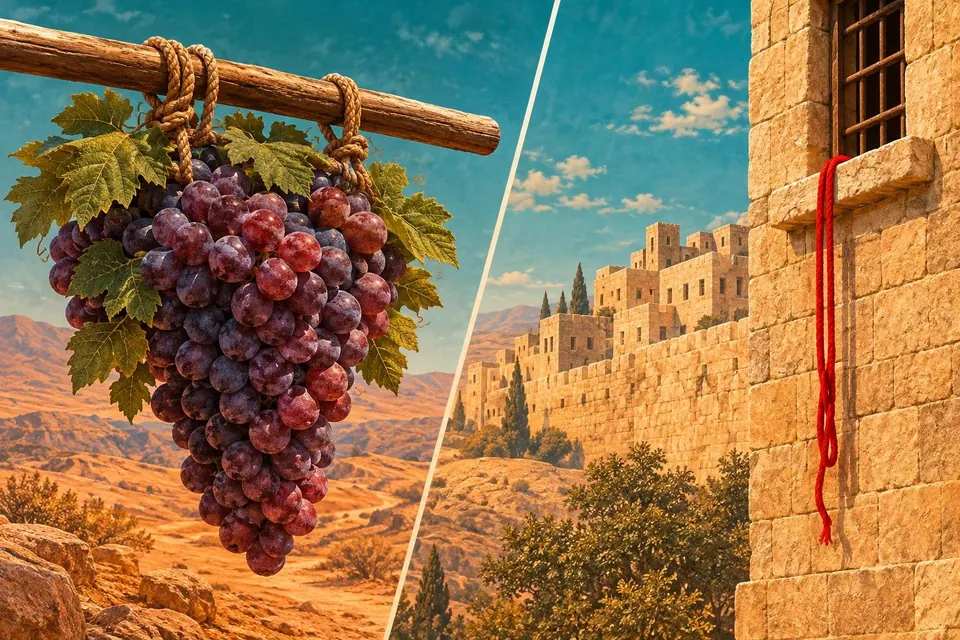
- The fruits really were enormous and beautiful—a land flowing with milk and honey!
- Even when the giants saw them and said, “There are people like ants in the vineyard,” they did not crush them.
Joshua’s spies found themselves in very different circumstances. Throughout their mission, the situation appeared dire:
- As soon as they reached the outer wall, the people of Jericho learned of their plans.
- They were unable to enter the city and report on its defenses.
- They had to return to Joshua that same night.
- Rahab, the prostitute with whom the spies stayed, lowered them from a window by a rope—a shameful way to leave a house, suitable for thieves or adulterers. Our Sages write that Rahab’s clients used this rope to climb up to her.
- To avoid capture, they had to hide in the mountains for three days.
What results might we have expected from these two groups of spies?
We might have expected Moses’ spies to return inspired by all the miracles they had witnessed and by the Divine Providence that had constantly saved them. The climax of their journey should have been the sight of fruits whose beauty and size were unlike anything else in the world.
How did they actually respond? They interpreted everything they saw negatively. The funeral processions they encountered everywhere proved, in their view, that some danger in the Land of Israel was shortening people’s lives. The fruits proved that it was a strange land, where unusual fruits grew. They had a real talent for finding fault with everything good!
We might have expected Joshua’s spies to respond like this—and if I had been a spy in their situation, I would have responded this way: “Righteous Joshua! We must strengthen our faith that, despite how difficult our situation is, God will help us. Jericho’s army is completely prepared! As soon as we arrived, the security forces knew why we had come and where we were staying. We barely escaped.”
But how did they actually respond? “God has indeed given the whole land into our hands, and all the inhabitants of the land are trembling before us” (Joshua 2:24). They knew this because all of Jericho’s military commanders were frequent visitors to Rahab, and she told the spies that they were all trembling with fear.
What accounts for these very different responses? We cannot say that Moses’ spies were not righteous, since our Sages and Rashi say that when they stood before Moses, they were righteous [Rashi on Numbers 13:3].
There are many answers to this question. I would like to suggest one, which is also consistent with some of the others.
In the case of Moses’ spies, it is clear that their negative response came from the fact that they simply did not want to see the good.
There are many explanations for why the spies wanted to speak disparagingly about the Land of Israel. According to one, they feared that they would lose their standing in society once they entered the land. According to another, they feared engaging with the material world and preferred to remain in the wilderness, in a spiritual world where manna came down from Heaven. According to a third, they wanted to continue living near Moses our teacher, who was not destined to enter the Land of Israel. In any case, they went on their mission not to see the truth, but to see what they wanted to see. And things turned out as they did.
Joshua’s spies needed something else in addition to a search for truth: “Do not follow ... your eyes” (Numbers 15:39). This principle is mentioned at the end of Parashat Shelach. It was the basis of the spies’ success: they did not place too much weight on appearances. Jericho’s army looked very strong. But Joshua’s spies understood that Rahab was telling the truth about their fear, and that the rest was a bluff.
A well-known story from much more recent times: in 1991, during the Persian Gulf War, Saddam Hussein fired 39 Scud missiles at Israel. Each could destroy several houses, carrying 750–900 kg of explosives. In the end, only two people were killed directly by missile strikes. Many miracles took place during that war. It would be logical to expect that, as a result, all Jews would return to faith and observance of the mitzvot. Why did that not happen?
My saintly father-in-law, Rabbi Yitzchak Zilber, explained that the missiles fell over a relatively short period, and people did not have time to reflect on what was happening. This was unlike the plagues in Egypt, each of which was reflected upon for a month.
It seems to me that a person who does not want to see God will not see Him, even if He performs miracles for them—just as happened with the spies. During that war, many people clearly saw the hand of God in what was happening. But as soon as it is all over, the evil inclination drives from a person’s soul the very desire to see the Creator’s goodness in events.
Can we learn something from this for ourselves? In the next-to-last blessing of the Amidah prayer, we say, “For Your miracles that are with us every day” [Amidah, Modim]. All that is required of us is to want to see the Holy One, blessed be He, in the events taking place around us.
By Rabbi Avraham Kuperman
Keep reading
More →Acharei Mot–Kedoshim: The Advice of a True Doctor
A Torah perspective on medical advice, hope, prayer, and the difficult work of giving and receiving warnings.
ParashaShelach: True Greatness Is Not Arrogance
The spies’ report offers a lesson in self-confidence, dignity, and humility.
ParashaChukat: Transition Periods in Life
Rabbi Yissocher Frand explores why times of change call for special care toward ourselves and our families.
ParashaChukat: Appreciate Your Loved Ones
The Song of the Well offers a lesson about recognizing the people we take for granted.







