Chayei Sarah: Knowing How to Give
A story about a rabbi, a governor, and an unusual way to save a Jewish school.
In brief
- Ephron offered Abraham a field for free but also named a price.
- The author explains how Abraham could have paid without embarrassing Ephron.
- In Brisk, a governor threatened to close the Jewish school and refused any hint of a bribe.
- Rabbi Chaim Soloveitchik found an unusual way to give the governor money and ask him to leave the school alone.
Parashat Chayei Sarah#
“Abraham weighed out to Ephron ... four hundred shekels of silver, passing to the merchants” (Genesis 23:16).
What does “passing to the merchants” mean? Our Sages explain that Ephron demanded large, high-quality coins that all merchants would accept. But Torat Chaim asks: In that case, the verse should have said “as accepted by merchants,” not “passing to the merchants.” Why does it use that wording?
Let me explain. Our forefather Abraham asked Ephron to “give it to me for its full price” [Genesis 23:9]. But Ephron replied, “No, my lord!” Not as you said, but: “Listen to me: I give you the field, and I give you the cave in it. In the sight of my people, I give it to you. Bury your dead” [Genesis 23:11]. And don't be afraid that I'll later deny giving it to you or change my mind.
But then Ephron added, “A piece of land worth four hundred shekels of silver—what is that between me and you?” How much is it worth? A measly four hundred shekels! Who cares about that? “Bury your dead!” [Genesis 23:15].
Abraham understood perfectly what Ephron was saying between the lines. Ephron had declared in front of everyone that he was giving away his field, but at the same time, he named the price he wanted for it. If Abraham gave him the money, he would embarrass him. And if he didn't, Ephron would find ways to dispute who owned the field. Abraham came up with a solution: He gave the money to a merchant, who found a way to slip it to Ephron. And everything ended well.
How do I know that's what happened? From a true story.
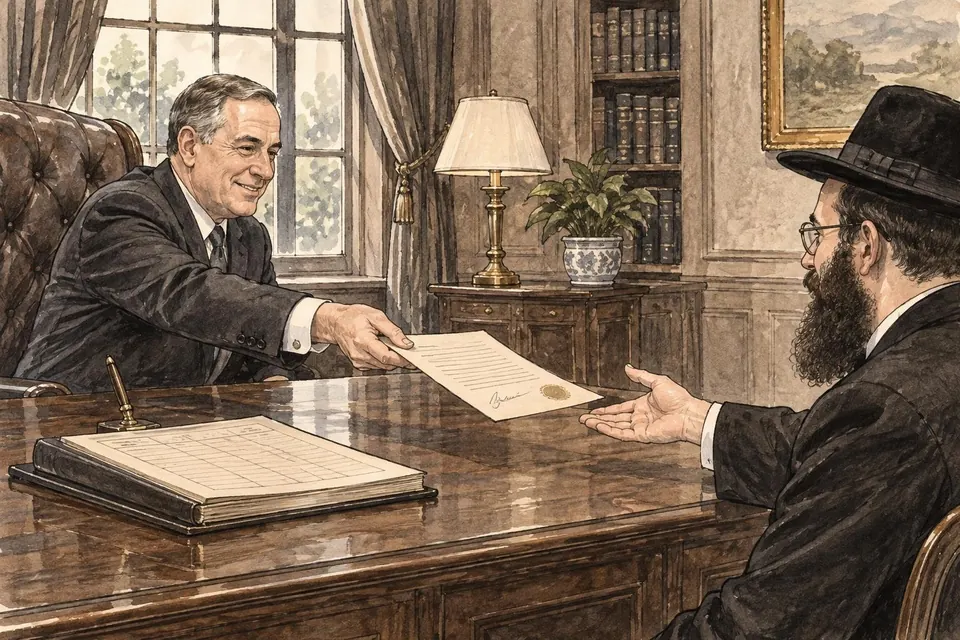
A new city governor took office in Brisk (Brest-Litovsk). One of his first acts was to order the city's talmud Torah (school for boys) to close within 30 days. There was plenty to find fault with: The classrooms were small and cramped, and there were too many children, thank God. The teachers had no formal qualifications. There was no playground for the poor children.
Well, the community trustees understood the hint. They went to the governor and carefully tried to find out how much money it would take to settle the matter. To their surprise, the new governor rose to his full height, his mustache bristling in every direction, and bellowed, “If I hear even a hint of a bribe, the person who offers it will end up behind bars! In 29 days your school will be closed!”
Confused and worried, the trustees turned to the city's chief rabbi, the great Rabbi Chaim Soloveitchik. What should they do?
The rabbi listened and waved his hand. “Leave it to me. Just tell me: How much were you planning to offer?”
“A thousand rubles,” they replied.
“Excellent,” said the rabbi.
The trustees went home puzzled. The rabbi sent a messenger to the governor to request a meeting. The governor replied that he would be glad to meet the rabbi and invited him to come the next day at ten in the morning.
It was summer, a hot, sunny day.
At ten, the governor's servant announced, “Your Excellency, the rabbi is here.”
“Well, show him in.”
The official rose to greet the rabbi and couldn't believe his eyes. The rabbi had come in a fur coat and a fur hat. He took off his mittens to shake hands and put his umbrella in a corner. Then he removed his coat, untied his wool scarf, and took off his heavy hat. Sweat was pouring off him.
The governor was stunned. Delicately, he asked, “Is this the official dress of a rabbi?”
“Not at all,” the rabbi replied. “If rabbis walked around in clothes like these in summer, everyone would laugh at them!”
The governor was speechless.
“I'll explain,” the rabbi said with a smile. “But this is a secret, Your Excellency. I'll share it with you. I had a grandmother who was a very righteous woman. She's surely in heaven now. Well, she appeared to me in a dream today and warned me that it would be terribly cold, with a downpour and snow. Since I was going out, I didn't want to take any chances. I dressed properly, just in case.”
The official glanced at the clear sky through the open windows and raised his eyebrows doubtfully. The rabbi agreed with him. “I understand, Your Excellency. I'd have my doubts too. But you didn't know my grandmother. Such a righteous woman, such a righteous woman ...”
The governor could barely contain his smile. But the rabbi was determined. “If you don't believe me, Your Excellency, that's your business. But I'm willing to bet that there will be heavy rain today, before sunset! I'll wager a thousand rubles against ten of yours!”
The official shrugged and went over to the window. He looked outside: There wasn't the slightest hint of a cloud. A hot wind blew in his face. “All right, I accept,” he said. How strange. Everyone he'd heard had praised the rabbi. They said he had a brilliant mind. Well, who could tell?
“Now,” said the rabbi, “I'd like to speak to you about the matter I came for ...”
“If you've come to talk about the talmud Torah, there's nothing to discuss! Everything has been decided. You have 28 days left!”
The rabbi sighed. “Well, that's what I expected, but I had to make an effort for the sake of raising our children in the spirit of the Torah.”
He got up, wrapped his scarf around his neck, put on his fur coat and hat, and picked up his umbrella. His heavy fur boots clattered across the wooden floor. The official smirked. Throughout the day he kept glancing out the window, until he saw a multitude of stars shining in the dark, cloudless sky. Well, the righteous grandmother had muddled the rabbi's mind. Which just goes to show that even the cleverest people can be fools.
The next day at ten in the morning, the servant announced, “The Jewish rabbi is here.”
The official rose to greet him. This time the rabbi was wearing a light silk coat and a cap. No fur coat or scarf, no boots or fur hat.
“Well,” the governor said with a smile, “your grandmother let you down, did she?”
“It happens,” the rabbi said with a shrug. “Still, I didn't want to take any chances. If you'd known her, you'd understand. I've come to pay what I lost.”
“Oh, come now,” the governor protested. “We weren't serious!”
But the rabbi replied without a trace of a smile. “If you'd lost, you would have sent me ten rubles, wouldn't you? I lost, so I must pay!”
True enough. The rabbi counted out a thousand rubles, and the official tucked them into his pocket. “Next time,” he suggested, “at least don't wear the fur coat. Just take it with you.”
“Everyone should learn from what happens in life,” the rabbi agreed. “And now I have one small request: Leave the talmud Torah alone!” And he walked out.
The governor sat down in astonishment, feeling the stack of banknotes in his pocket. Yes, the people who said the rabbi had a brilliant mind were right ...
By Rabbi Yaakov Galinsky
Keep reading
More →Acharei Mot–Kedoshim: The Advice of a True Doctor
A Torah perspective on medical advice, hope, prayer, and the difficult work of giving and receiving warnings.
ParashaShelach: True Greatness Is Not Arrogance
The spies’ report offers a lesson in self-confidence, dignity, and humility.
ParashaChukat: Transition Periods in Life
Rabbi Yissocher Frand explores why times of change call for special care toward ourselves and our families.
ParashaChukat: Appreciate Your Loved Ones
The Song of the Well offers a lesson about recognizing the people we take for granted.







