Why Were the Midwives Called Shifra and Puah?
The names of the Hebrew midwives reveal the care they gave even to the smallest needs of Jewish children.
In brief
- Rashi identifies Shifra and Puah as Yocheved and Miriam.
- Their names describe how they cared for and comforted newborns.
- Their attention to small needs showed that they were mothers to the Jewish people.
- Rabbi Shlomo Heiman taught that caring for a bride meant attending to details as a mother would.
Parashat Shemot#
“The king of Egypt spoke to the Hebrew midwives. The name of one was Shifra, and the name of the other was Puah” (Exodus 1:15).
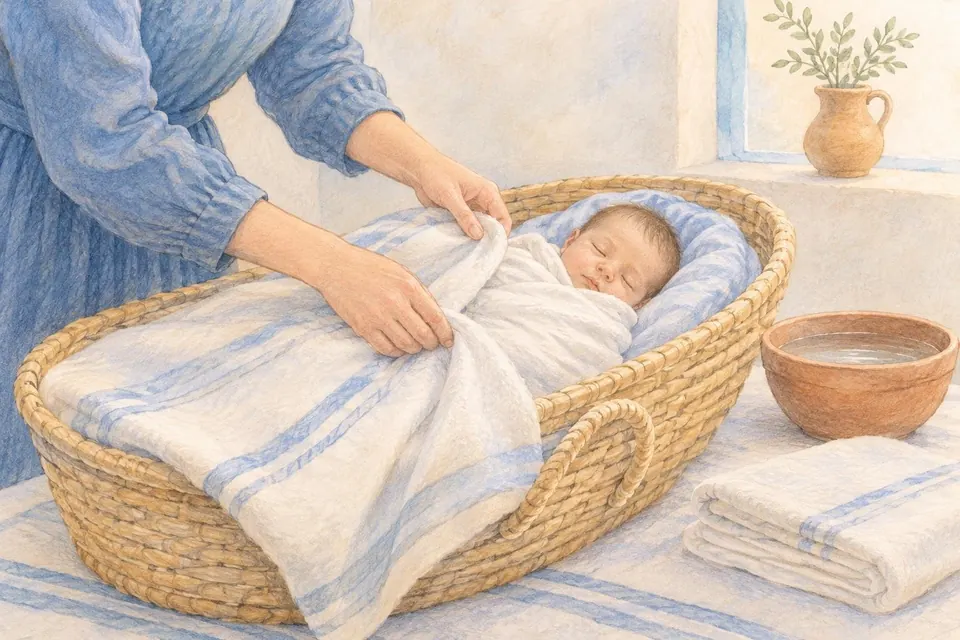
“Shifra was Yocheved, because she would improve (from the word leshaper, meaning to beautify and set in order) the newborn. Puah was Miriam, because she would speak gently and coo (poah in Hebrew) to the baby, as women do to calm a crying child” (Rashi on Exodus 1:15).
The midwives mentioned in this verse are Yocheved, the mother of Moses our teacher, and her daughter, the prophetess Miriam.
Yocheved was a great and important woman of her generation. At the time, she was 123 years old, the daughter of Levi and one of the 70 members of Jacob’s family who went down to Egypt. Miriam was a prophetess of God. Why does the Torah call them by other names instead of their honored names?
What is more, these names seem merely to describe their work: Shifra made the babies look better and more presentable, while Puah amused them. They sound like the names of ordinary midwives. Do these names convey their extraordinary courage in saving Jewish children under threat of death?
In fact, these names reveal their greatness more than anything else.
Imagine a baby who is gravely ill in the hospital. Doctors and nurses are working hard and giving their all to save the child. If, at that moment, we see a woman smiling at the baby and speaking gently, we know for certain that she is the mother. Those trying to save the child are engaged in a great task and have no time for minor details. Only the mother, because of her immense love for her baby, pays attention even to the smallest things.
Likewise, although Yocheved and Miriam put themselves in danger to save the people of Israel, that alone does not prove that they were mothers to the Jewish children. Nor would it have earned them the privilege of becoming the ancestors of Levites, priests, and kings.
Yet even when Jewish children were in such terrible danger, when they were being killed and thrown into the Nile, Yocheved and her daughter remained “Shifra” and “Puah.” Even then, they had the composure to tie pretty bows on the babies, speak gently to them, and care for all their needs, including small things on which no life depended. All this shows that they were true mothers to the house of Israel, and that is why they earned such great distinctions.
There is a story about Rabbi Shlomo Heiman, one of the great heads of yeshivas in the previous generation.
He devoted himself to spreading Torah, while his righteous wife spent her life doing good deeds. She especially helped poor orphaned girls get married.
Once, she was preparing to attend the wedding of such a girl. She had taken care of everything the bride needed for her dowry, from beginning to end. The wedding itself had also been arranged with money she had raised. Suddenly, Rabbi Shlomo asked, “Did you buy a bouquet of flowers for the bride?”
His wife replied, “I didn’t think we needed to arrange every little detail, especially when everything is being paid for with donations.”
“No, no,” Rabbi Shlomo said. “Hurry and buy the bride flowers.”
The simple reason was that the bride should have everything her friends had. But there was a deeper meaning too. Rabbi Shlomo meant: “A mother would certainly buy flowers for her daughter’s wedding. Be like a mother, not a fundraiser. As it says, ‘I am a father to the needy’ [Job 29:16].”
That is why the names Shifra and Puah express the remarkable greatness of Yocheved and Miriam in the best possible way.
By Rabbi Shimshon Pincus
Keep reading
More →Acharei Mot–Kedoshim: The Advice of a True Doctor
A Torah perspective on medical advice, hope, prayer, and the difficult work of giving and receiving warnings.
ParashaShelach: True Greatness Is Not Arrogance
The spies’ report offers a lesson in self-confidence, dignity, and humility.
ParashaChukat: Transition Periods in Life
Rabbi Yissocher Frand explores why times of change call for special care toward ourselves and our families.
ParashaChukat: Appreciate Your Loved Ones
The Song of the Well offers a lesson about recognizing the people we take for granted.







