Vayishlach: Satan’s Song
Jacob’s struggle with an angel sheds light on the purpose of the evil inclination and a confession on Yom Kippur.
In brief
- An angel struggled with Jacob all night and then said his time had come to sing to the Creator.
- The Zohar describes the tempter’s purpose through a parable about a king testing his son.
- The evil inclination presents a test that it wants us to overcome.
- A Yom Kippur confession can be understood as acknowledging a wrong done to the evil inclination.
The Portion of Vayishlach#
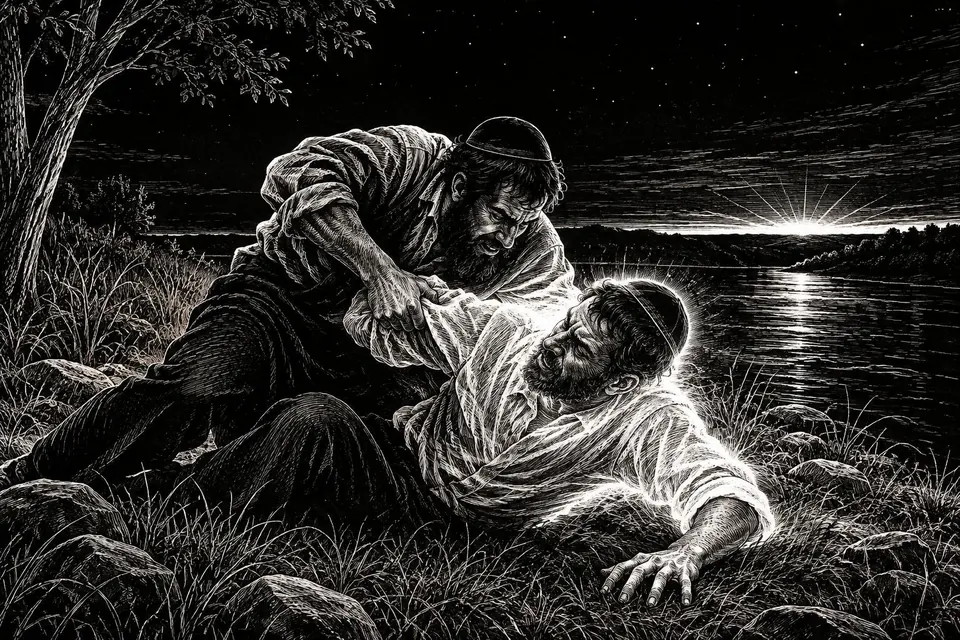
Our forefather Jacob was left alone when he met Esau’s angel, who wrestled with him all night. The angel appeared to him in different guises: as an idol worshipper, a Torah scholar, a fearsome robber, and a shepherd. He tried to inflict a flaw on Jacob’s perfection.
“When he saw that he could not defeat Jacob … he said to him, ‘Let me go, for dawn has broken.’ Jacob said to him, ‘Are you a thief or a robber, that you fear the dawn?’ He replied, ‘I am an angel, and since the moment I was created, my time to sing to the Creator has not come—until now’” (see Chullin 91b).
We need to understand why the angel’s moment to sing to the Creator came just then.
An angel’s song is the fulfillment of its purpose. What is Satan’s purpose? Why was he created? At first glance, it seems that he was created to make people sin. But that is not so.
The holy book of the Zohar tells a parable: A king decided to test his son’s loyalty. He ordered one of his courtiers to try to persuade the son to rebel against him. What did the king want? He wanted his son to withstand the test and refuse to listen to the courtier. Then the king would love his son even more and reward the courtier generously. But if the courtier succeeded in prompting the son to rebel, the king would be angry with his son—and even more so with the courtier.
Since the beginning of the world, Satan had tried to tempt people to sin—and had succeeded. But his time to sing had not come, because the Creator, blessed be He, was displeased with these “successes.” Only when Satan could not touch our forefather Jacob did his time to sing arrive.
It follows that when we sin, God forbid, we harm the evil inclination. It wanted us to withstand the test, so why did we listen to it?
Now we can understand why we say on Yom Kippur, “For the sin that we have sinned before You through the evil inclination.” Why, we might ask, should we say this separately? We commit every sin because of the evil inclination. As it says in tractate Berakhot [17a], “It is revealed and known to You that we wish to do Your will. What prevents us? The leaven in the dough.” The leaven refers to the evil inclination, which leads us to sin. So why confess this separately?
In fact, we are confessing a sin we committed against the evil inclination. It placed a test before us so that we would overcome it, but we gave in. And our King, our Father, is angry with us—and with it…
By Rabbi Yaakov Galinsky
Keep reading
More →How to Do Teshuvah: Practical Steps
A practical approach to making lasting commitments as part of teshuvah.
Yom KippurWhy Do We Fast on Yom Kippur?
The Yom Kippur fast invites repentance and offers a mitzvah that lasts throughout the day.
Rabbi Shalom Schwadron's Stories of Repentance and Prayer
Yom KippurWhy Is Yom Kippur a Joyful Day?
Yom Kippur brings the joy of forgiveness, renewal, and a return to Torah.







