The Whole Torah on One Foot
How does loving your neighbor lead to a life devoted to God?
In brief
- Hillel taught that the whole Torah rests on not doing to another what you hate.
- Rashi offers two explanations of who the “other” is: God or another person.
- Love of another person can lead to love of the Creator.
- Overcoming selfishness allows a person to recognize both other people and God.
“Love your neighbor as yourself; I am the Lord” (Leviticus 19:18).
There is a well-known story in the Talmud (Shabbat 31a). As widely known as it is, it is just as difficult to understand. Thank God, it seems we have found a key to understanding it.
Hillel and Shammai#
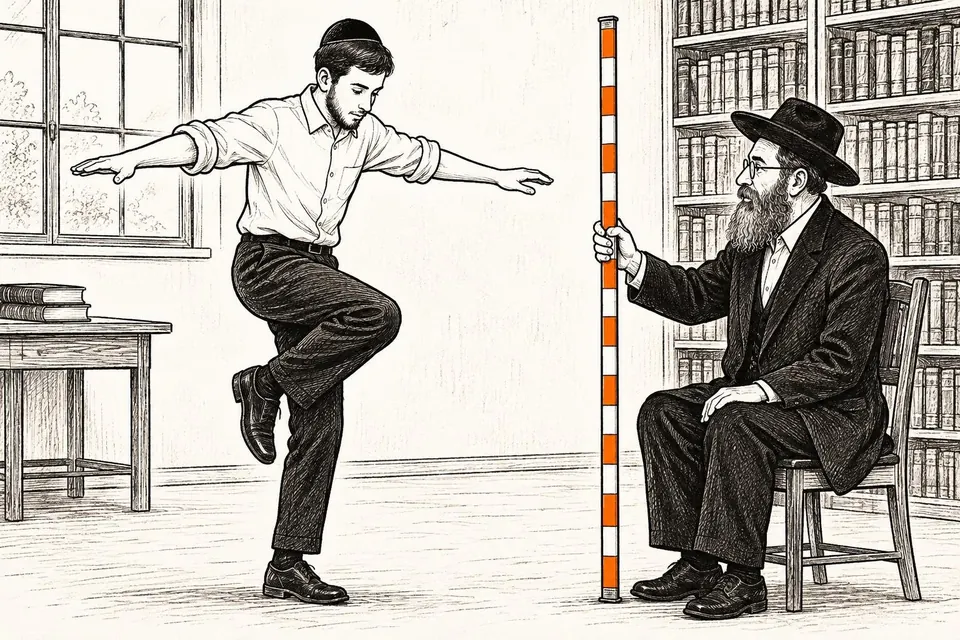
A non-Jew came to the great Shammai and said, “Convert me on the condition that you teach me the whole Torah while I stand on one foot.” Shammai drove him away with the builder’s measuring rod he had in his hand.
Our Sages wonder: Was Shammai a builder? We know that he was the head of a rabbinical court, and a person in that position may not practice a trade in public (Kiddushin 70a). In fact, Shammai was explaining to the man that perfection must be built brick by brick—which is also why, incidentally, the Sages are called “builders.” It cannot be achieved “on one foot.”
The non-Jew then came to Hillel, who agreed to accept him. “What is hateful to you, do not do to another,” he told him. “That is the whole Torah. The rest is commentary. Go and learn.” He managed to say it all while the man stood on one foot.
Rashi offers two explanations of who the “other” is. Proverbs says, “Do not abandon your friend or your father’s friend” (Proverbs 27:10). This refers to God: Do not disregard His will, just as you would hate for another person to disregard yours. The second explanation is that “the other” means another person, and the teaching refers to all the mitzvot governing relationships between people—for example, the prohibitions against stealing, robbery, adultery, and so on.
Two Meanings of “The Other”#
The first explanation is wonderful according to drash, the deeper level of Torah interpretation. In the Mekhilta, in the section Bachodesh, chapter 8, the Sages place the first five of the Ten Commandments on the Tablets of the Covenant opposite the second five. For example, “Remember the Shabbat day to make it holy” is opposite “Do not bear false witness against your neighbor.”
Why? Because anyone who violates Shabbat is, as it were, testifying before the Creator that He did not create the world in six days and rest on the seventh. And anyone who keeps Shabbat testifies before the One whose word brought the world into being that He created it in six days and created rest on the seventh, as it says: “You are My witnesses, declares the Lord” (Isaiah 43:12).
The Meiri adds that the commandment says, “Do not bear false witness against your neighbor.” And the Midrash on Psalms says that the words “This is my beloved, and this is my friend” (Song of Songs 5:16) refer to God, just as the verse from Proverbs quoted above does.
But it is not so easy to say this to a non-Jew and expect him to figure out that “the other” means God, in light of the verse in Proverbs.
Even if we take the explanation that “the other” means another person, and that the teaching concerns prohibitions governing relationships between people—“for example, the prohibitions against stealing, robbery, adultery, and so on,” as Rashi says—how can we explain Hillel’s words that “this is the whole Torah, and the rest is commentary”? How does this include the mitzvot between a person and God? These include such serious matters as keeping Shabbat, the prohibition of idolatry, keeping kosher, and much else.
From Love of Others to Love of God#
On a deeper level, however, the two explanations come together. Let us quote the author of Siftei Kohen on the verse in our portion: “Love your neighbor as yourself; I am the Lord.” Rabbi Akiva said that this is a great principle of the Torah.
Siftei Kohen quotes Hillel and writes: “This teaches us that love of one’s neighbor includes all the mitzvot governing relationships between people, both positive commandments and prohibitions. And love of one’s neighbor will lead a person to love the Creator, and from there to knowledge of the divine commandments”—that is, those between a person and the Creator.
The book Sefer HaChinuch explains the meaning of the mitzvah to honor one’s parents: If a person roots gratitude to their parents in their heart, it will lead them to gratitude toward the Creator. This is precisely why this commandment appears among the Ten Commandments on the side devoted to the relationship between a person and God. So if a person roots love of their neighbor within themselves, they can also root love of the Creator and a sense of duty toward Him.
Let us explain. The greatest obstacle to a person’s spiritual growth is their inborn selfishness. From birth, a person is aware of themselves, occupied with themselves, feels their own needs, and seeks to satisfy their desires. Everyone else—their mother and those around them—is either a servant who fulfills their wishes or an enemy who gets in their way.
As the verse says, “A human being is born a wild donkey’s colt” (Job 11:12): selfish and ready to throw off any yoke. And so a person grows up in their selfishness. They know that there is a Creator of the world who commanded us to fulfill the Torah and its mitzvot. They know that there are other people in the world, with rights, desires, and feelings of their own. But this knowledge does not restrain them.
“The wicked know that their path leads to death, but they have fat covering their kidneys” (Shabbat 31b)—an insulating layer that separates understanding from behavior. As Rabbi Moshe Chaim Luzzatto (the Ramchal) says in Derech Etz Chaim: “If people saw reality in its true light, they would never sin in their lives. The evil inclination would not even approach them or gain power over them, just as it has no power over the angels.”
If so, only one thing is needed: to come out of the snail shell of selfishness. Then a person will see both their neighbor and their Creator, respect their neighbor’s rights, and fulfill their duties toward the Creator. How simple.
The Upstairs Neighbor#
Otherwise, a person has no hope of changing. Consider an example from Bava Batra 6b. Two people lived in the same house, one downstairs and the other upstairs. The foundations were unstable, the ground was sandy, and the house began to sink.
The downstairs neighbor said to the upstairs neighbor, “Let’s rebuild the house.”
“My apartment is fine,” the other replied. In fact, he had fewer stairs to climb.
Then the downstairs neighbor suggested, “I’ll tear down the house and rebuild it myself”—at his own expense, from the beginning, with a solid foundation.
“I’ll have nowhere to live while you build,” the upstairs neighbor replied. Fair enough.
“I’ll rent you an apartment at my expense,” said the downstairs neighbor.
“That’s too much trouble for me,” the other answered. He would have to take apart his furniture and move. That really was a bother.
The downstairs neighbor protested, “But I can’t live like this!” The ceiling had sunk to a height of 1 meter (about 3.3 feet).
The upstairs neighbor answered, “Crawl in and crawl out!” Like a snake, crawl on your belly and eat dust.
Rav Chama said, “According to the letter of the law, the upstairs neighbor is not required to accommodate him.” Yes, he is legally in the right, but he is a scoundrel, as if with the Torah’s permission. He does not put himself in his neighbor’s place for a second or consider what it would be like if their situations were reversed. He does to his neighbor what he himself hates.
And someone who sees nothing but themselves sees neither their neighbor nor their Creator.
Keep reading
More →Acharei Mot–Kedoshim: The Advice of a True Doctor
A Torah perspective on medical advice, hope, prayer, and the difficult work of giving and receiving warnings.
ParashaShelach: True Greatness Is Not Arrogance
The spies’ report offers a lesson in self-confidence, dignity, and humility.
ParashaChukat: Transition Periods in Life
Rabbi Yissocher Frand explores why times of change call for special care toward ourselves and our families.
ParashaChukat: Appreciate Your Loved Ones
The Song of the Well offers a lesson about recognizing the people we take for granted.







