Let All Who Are Hungry Come and Eat
A Passover Seder raises a question about religious stringencies and our obligations to others.

In brief
- A person with only three matzahs may wonder what to give a needy guest at the Seder.
- The author says to set aside stringencies when someone needs help.
- He applies the same lesson to Noah planting a vineyard after the flood.
- The Chazon Ish distinguished what the law requires from voluntary stringencies that may come at others' expense.
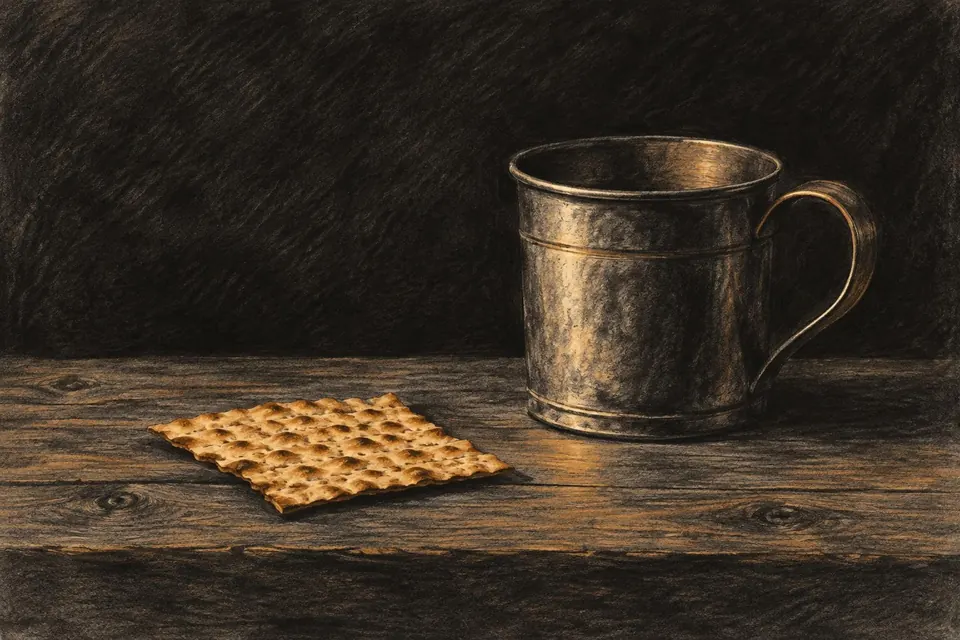
We are told that “even the poorest person in Israel must not eat until they recline, leaning on the left side” [Mishnah Pesachim 10:1; Pesachim 108a]. Suppose a poor person has just three matzahs for the Passover Seder. Each matzah has a role: the top and bottom ones serve as the “double bread,” the middle one is for the afikoman (matzah eaten at the end of the meal), and the bottom one is also needed for the korech sandwich of matzah and bitter herbs.
We begin the Haggadah: “Let all who are in need come and eat.” But what if the door actually opens and a poor person walks in? What will the host give them? He has only three matzahs. He needs two kezayit (an olive's volume) to fulfill the mitzvah of eating matzah(ideally; if that is not possible, one is enough—translator's note)one kezayit for korech, and another two for the afikoman. What is left?
The answer is this: when a person in need is before you, set aside all the stringencies and make do with one kezayit.
Of Noah, it is said: “Noah, a man of the soil, was the first to plant a vineyard” [Genesis 9:20]. The Sages explain that Noah descended spiritually, going from a “blameless righteous man” [Genesis 6:9] to a “man of the soil.” Why? Why not say that he planted a vineyard for a lofty purpose: to have wine for Kiddush?
The answer is that of course he intended to have wine for Kiddush. But if the whole world has been destroyed, do not think about stringencies! Sow wheat and bake bread to satisfy the hunger of everyone around you, and say Kiddush over the challah.
We all know about the Chazon Ish's stringencies, but I personally heard him say, “I don't adopt stringencies. I just observe the laws meticulously!”
I asked him, “What's the difference between a stringency and meticulous observance of the law?” He smiled and answered, “When the law says you must be stringent, that's the law. When the law permits a leniency and a person chooses to be stringent, that's their right. But they need to know that the law doesn't require it. So before adopting a stringency, they should check whether it will come at someone else's expense!”
“Let me tell you,” he added. “I have two neighbors. One is wealthy, and the other is destitute, with nothing in his house. Once I asked the wealthy man, ‘Do you know that your neighbor is completely destitute?’ It turned out he did. I suggested, ‘You're a man of means. Perhaps you could set aside a monthly sum to help him?’
“He answered, ‘You see, Rabbi, on Purim there's a mitzvah to give gifts to the poor. Of course, we give to everyone who stretches out a hand. But it's not easy to find people who are truly poor. How am I supposed to fulfill this mitzvah? My neighbor here—I know he's really destitute, and by giving to him I can fulfill the mitzvah in the best possible way! That's why I don't want to lift him out of poverty.’
“There's an example of a ‘stringency’ for you!”
By Rabbi Yaakov Galinsky
Keep reading
More →Passover Wine: What to Drink at the Seder
The four cups are a central part of the Seder, and grape juice can be used when wine is difficult to drink.
Guide · PassoverWhat Goes on a Seder Plate?
- 1. Zeroa
- 2. Beitzah
- 3. Maror
How Did the Klausenburger Rebbe Find Matzah in a Nazi Camp?