Why Were There Ten Plagues in Egypt?
The Kli Yakar explains how the plagues challenged three misconceptions about God.
In brief
- Rabbi Yehudah divided the ten plagues into three groups.
- The Kli Yakar says their number, sequence, and grouping were not accidental.
- The first group demonstrated that God exists, and the second showed that He directs events on earth.
- The third group showed that God alone rules over all the forces of the world.
“Rabbi Yehudah divided the ten plagues into three groups: Datzach, Adash, Bachav” (Passover Haggadah).
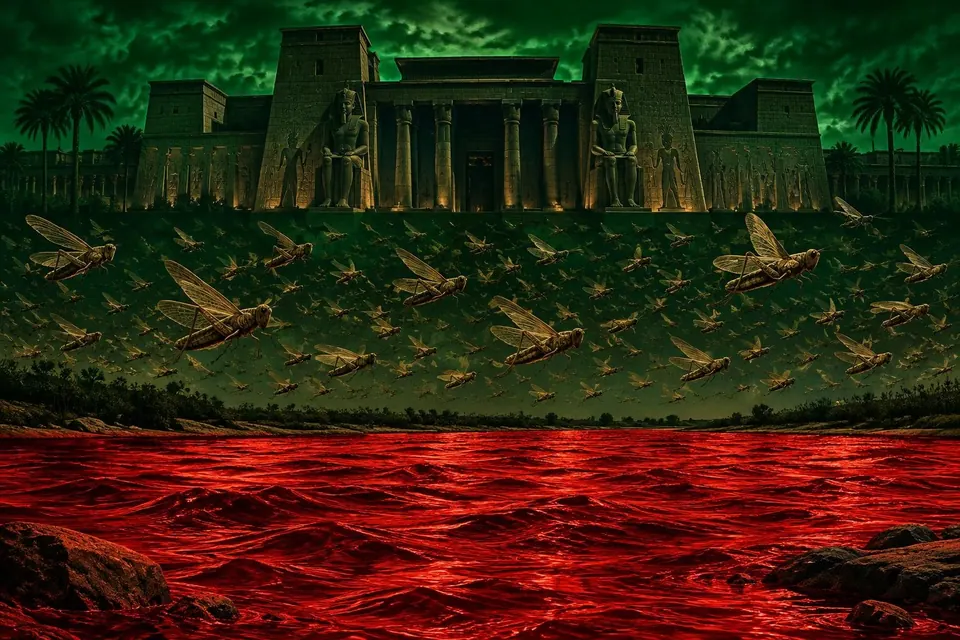
Datzach: 1. dam (blood), 2. tzefardeim (frogs), 3. kinim (lice).
Adash: 4. arov (wild animals), 5. dever (livestock disease), 6. shechin (boils).
Bachav: 7. barad (hail), 8. arbeh (locusts), 9. choshech (darkness), 10. bechorot (firstborn).
The ten plagues in Egypt, together with the warnings and intervals between them, lasted about a year. But why did Egypt need to undergo such a long ordeal? If God had wanted to force the Egyptians to set the Jews free, surely He could have sent one long, severe plague until He achieved His goal and they were allowed to leave. The Kli Yakar’s commentary on Parashat Vaera says that the number of plagues, their sequence, and their division into three groups were not accidental. What purpose did they serve?
In those distant times, there were three main ways in which people denied the foundations of faith.
The first was an ideology similar to modern atheism. Its followers claimed that the world had always existed and that no one created it. It developed on its own or came about through an explosion.
The second group believed that God existed and had created the world, but that He had not intervened in it since. They presented this position as a theory of the “greatness of the Creator”: He was so great and exalted that it was beneath His dignity to concern Himself with events in our lowly world. In other words, this group denied ashgachah pratit, God’s individual supervision and guidance of all His creatures.
The third belief system denied God’s unity. The world had indeed been created by the Creator, and He controlled everything that happened, but He was not alone: other forces also took part in governing the world.
The commentators say that God sent the Egyptians ten plagues, three in each group, to dispel these misconceptions and teach the whole world whom it should believe in.
Each group of three plagues is preceded by a verse pointing to the problem the next three plagues will address. The first cycle, which teaches belief in the Creator, is introduced by the verse: “Thus says the Lord: By this you will know that I am the Lord. I will strike the water in the river with the staff in my hand, and it will turn to blood” (Exodus 7:17). Atheists need proof that God exists, and the first three plagues demonstrate this through their nature.
- Blood. Turning water into blood changes nature, showing that there is a power that rules over nature and can change it. It was also symbolic that the Nile, which the Egyptians regarded as a deity, was struck.
- Frogs. The frogs multiplied—or a single frog multiplied—in defiance of all the laws of nature, and an Egyptian deity was once again struck.
- Lice. After this plague, even the magicians concluded that it had been brought about by God’s hand.
Pharaoh and his people became convinced that God exists, and now they could move to the next level. Before the second group of plagues, a verse explains what the idol worshippers would be taught this time. They believed that God was in heaven and did not intervene in events on earth: “So that you will know that I am the Lord in the midst of the earth” (Exodus 8:22).
- Wild animals. Wild animals filled the land of Egypt, but there were none in the land of Goshen, where the Jews lived. This shows that God controls events on earth and distinguishes between neighboring regions.
- Livestock disease. Once again, a difference can be seen between neighboring regions. The Egyptians’ livestock died, while the livestock of their Jewish neighbors were unharmed.
- Boils and sores. The same principle applied: the Egyptians had them, but the Jews did not.
Those who held the third belief needed to learn that there is only one God in the world. These plagues are introduced by the verse: “So that you will know that there is none like Me in all the earth” (Exodus 9:14).
- Hail. For those who believed that many deities ruled over different forces or elements, God sent hail with fire burning inside it. Water and fire, joined together although they cannot coexist under ordinary conditions, point to the power of one force—God—over everything in the world.
8, 9, and 10. These plagues demonstrate that God rules over the winds that bring and carry away the locusts, over light and darkness, and over life and death, as demonstrated in the plague of the firstborn.
Keep reading
More →Passover Wine: What to Drink at the Seder
The four cups are a central part of the Seder, and grape juice can be used when wine is difficult to drink.
Guide · PassoverWhat Goes on a Seder Plate?
- 1. Zeroa
- 2. Beitzah
- 3. Maror
How Did the Klausenburger Rebbe Find Matzah in a Nazi Camp?